Bees are fascinating creatures that play a crucial role in pollinating crops and producing honey. Their complex social structure and division of labor within the hive make them remarkable insects. Understanding their anatomy and physiology helps us appreciate how they manage these tasks.
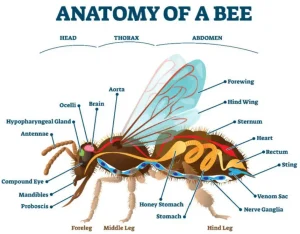
Body StructureBees, like all insects, have three main body parts: head, thorax, and abdomen.
Head: Contains sensory organs like compound eyes for detecting movement and ultraviolet light, simple eyes (ocelli) for light intensity, and antennae for smell, taste, and touch. The mouthparts include mandibles for biting and a proboscis for sucking nectar.
Thorax: Houses muscles for flight and legs. Bees have two pairs of wings and three pairs of legs, each specialized for walking, grooming, or collecting pollen.
Abdomen: Contains digestive and reproductive organs, sting apparatus, and wax glands used to build honeycomb.
Internal Anatomy
Digestive System: The crop stores nectar, the midgut digests nutrients, and the hindgut reabsorbs water and excretes waste.
Respiratory System: Bees breathe through spiracles connected to a network of tracheae and air sacs.
Circulatory System: Open system with hemolymph (insect blood) circulated by the dorsal vessel.
Nervous System: Brain and ventral nerve cord control sensory processing and body functions.
Physiology and SensesBees have advanced sensory systems for survival:
Sight: Compound eyes detect movement and UV light; ocelli help with flight stability.
Smell: Antennae detect pheromones for communication and locating flowers.
Taste: Receptors on the antennae, mouthparts, and feet evaluate nectar and pollen.
Touch & Vibration: Sensory hairs help with navigation and hive communication.
Behavior and CommunicationBees use pheromones to communicate:
Queens produce pheromones that maintain social order.
Workers release alarm pheromones for danger alerts.
Foragers perform the waggle dance to indicate food location.
Division of Labor
Queen: Lays eggs and regulates worker behavior.
Workers: Female bees with roles that change with age – nursing, hive maintenance, foraging, and defense.
Drones: Male bees primarily for mating with a queen.
Hive Structure
Honeycomb: Hexagonal wax cells for brood, honey, and pollen.
Brood Cells: Eggs develop into larvae and pupae.
Honey Cells: Nectar converted into honey, stored, and capped with wax.
Pollen Cells: Protein source for larvae.
Lifecycle of a BeeBees undergo complete metamorphosis: egg → larva → pupa → adult. The queen lays eggs, larvae are fed royal jelly and bee bread, pupae develop adult features, and adults emerge to perform their hive roles.
Understanding bee anatomy and physiology helps us appreciate their sophisticated behavior and the hive's efficiency. Protecting bee populations is essential for biodiversity and crop pollination, ensuring the health of our ecosystems and food systems. Reference
Fujairah Research Centre