Authors: Reem Yaqoub Yousif Ahmed Abdalla, Aseela Al Moalla, Mohamed Ateeg, Muhammed Sirajul Huda Kalathingal, shaher Bano, Fouad Lamghari Ridouane
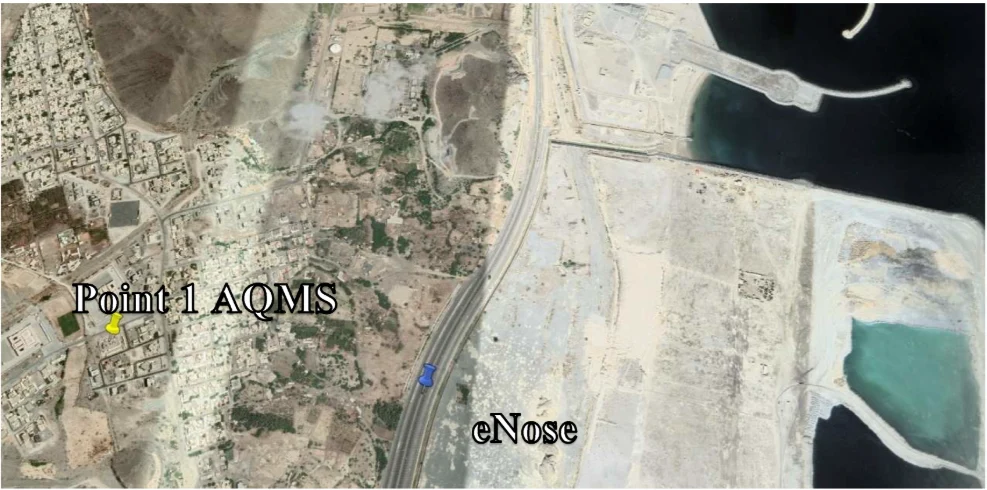
Urban monitoring site showing the location of Point 1 air quality monitoring station (AQMS) and eNose sensor on Google Earth Pro for non‑methane hydrocarbon fingerprint characterization and windspeed–concentration correlation analysis.
Abstract: Multiple sources influence air quality and regional climate in complicated atmospheric emission situations like urban agglomerations. To resolve pollution plumes and source influences in polluted areas, a comprehensive chemical fingerprinting of sources utilizing non-methane hydrocarbons (NMHCs) and the identification of acceptable tracer molecules and emission ratios is required, in contrast to pristine locations, where reliance on a single or a few chemical tracers is frequently sufficient. We have characterized the prevalence of NMHCs fingerprints in the urban areas and quantified the correlation of windspeed with the concentration of these pollutants. eNose sensors and Air quality management stations provide the data to identify the emission sources of such pollutants. Based on our analysis, the average NMHC concentration in 2021 has been recorded 0.424 ppm at point 1 AQMS whereas at point 2 AQMS it was 0.256 ppm. Such outcomes could be attributed to the proximity of emissions sources, the direction and speed of the wind, or both. Moreover, traffic can be a major contributor to pollution levels in any urban area. More research based on a larger dataset is required before definitive conclusions can be drawn, and viable solutions can be proposed.
Reference: