AUTHORS:James Arruda Salomea, b,c, *, Shaher Bano Mirzac , Fouad Lamghari Ridouanec a Al Taiba Farms, Fujairah, United Arab Emirates. b Al Mayya Group, Fujairah, United Arab Emirates. cFujairah Research Centre, Sakamkam Road, Fujairah, United Arab Emirates.
Abstract:- The honey that is produced by the bees using excretions of plant-sucking insects (Hemiptera) is called honeydew honey. The main differentiating factors of blossom honey and honeydew honey are the sugar composition and electrical conductivity. The higher fructose contents and electrical conductivity makes honeydew honey better than other types of honey. Honeydew honey has a rich composition of nutrients in its content and can be a dietary supplement and has therapeutic uses, besides antioxidant and antimicrobial properties. Few countries in the world especially Turkey, Greece, Germany, Spain, and Bulgaria, have the necessary environmental conditions for producing this rare type of honey. In the United Arab Emirates, among ten honey samples harvested in different regions of the Emirate of Fujairah, all can be considered honeydew honey showing average electrical conductivity higher (1.4030 mS/cm) compared to foreign samples (1.0968 mS/cm). Furthermore, fructose, glucose, and inverted sugars are similar to the levels of monosaccharides found in honeydew honey samples studied in other countries. Keywords:- beekeeping in UAE; honeydew; honeydew honey in UAE; electrical conductivity in honeydew honey; honeydew honey composition.
“Comparison Analysis of Honeydew Honey Production and Quality in Fujairah, U.A.E and Other Regions of the World” (IJISRT, Oct 2022)Honeydew-Honey-Production
Overview
The study, co-authored by James Arruda Salome, Shaher Bano Mirza, and Dr. Fouad Lamghari Ridouane from the Fujairah Research Centre, investigates the characteristics of honeydew honey produced in the Emirate of Fujairah and compares it with global samples from major producer nations such as Turkey, Greece, Bulgaria, Poland, and Spain. Honeydew honey, unlike blossom honey, originates from excretions of sap-sucking insects (Hemiptera) feeding on plant phloem rather than floral nectar, giving it distinctive chemical and nutritional properties.
Key Findings
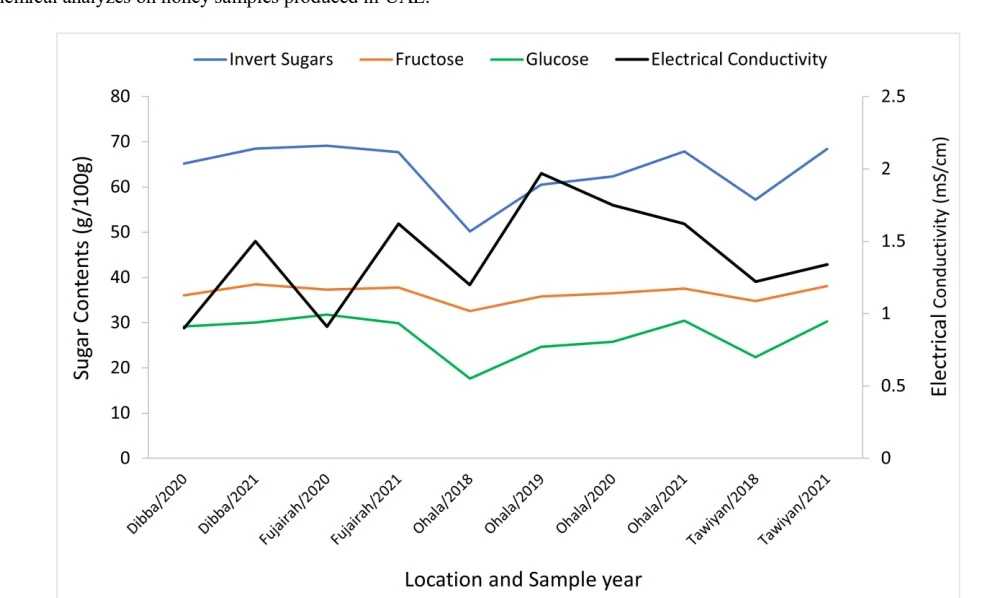
Chemical Composition:Fujairah samples showed average fructose 36.49 g/100 g and glucose 27.21 g/100 g, statistically similar to international counterparts. Invert sugars (fructose + glucose) averaged 63.7 g/100 g, confirming the typical honeydew signature.
Electrical Conductivity (EC):The UAE samples exhibited a higher mean EC of 1.403 mS/cm than foreign averages (1.097 mS/cm). EC > 0.8 mS/cm is the defining criterion for honeydew honey, demonstrating that all ten Fujairah samples qualify. The Ohala 2019 sample reached 1.97 mS/cm, the highest value recorded.
Geographical Variation:Within Fujairah, notable EC differences across Dibba, Fujairah city, Ohala, and Tawiyan reflect micro-climatic effects, soil mineral composition, and local vegetation.
Global Context:Turkey remains the largest producer (≈ 15 000 tons per year, 30–50 % of its total honey output), followed by Greece (65 % of its production), Bulgaria (Strandzha region, EU PDO-certified), Spain, Poland, and Brazil. Production is tied to the interaction between conifer or oak species and specific scale insects (e.g., Marchalina hellenica on pines or C. pectinatae on fir).
Functional Properties:Honeydew honey displays higher phenolic content, ash, and antioxidant capacity than blossom honey, along with notable antimicrobial activity against multidrug-resistant bacteria (S. maltophilia and others). These traits make it valuable for therapeutic and dietary applications.
Conclusions
All analyzed Fujairah honeys are confirmed honeydew honeys, with comparable sugar profiles but superior electrical conductivity relative to traditional producer countries. This marks the first documented evidence of large-scale honeydew honey production in the UAE, highlighting Fujairah’s unique ecological conditions conducive to this rare honey type. Future research will focus on identifying host plants and sap-sucking insects responsible for the excretions collected by Apis mellifera bees, expanding the study to other Emirates, and correlating composition with environmental variables.
Acknowledgments
This research was funded by H.H. Sheikh Mohammed bin Hamad Al Sharqi, the Al Mayya Group, and the Fujairah Research Centre, demonstrating Fujairah’s strategic commitment to advancing apicultural science and positioning the UAE as a global player in high-quality, therapeutic honeydew honey production