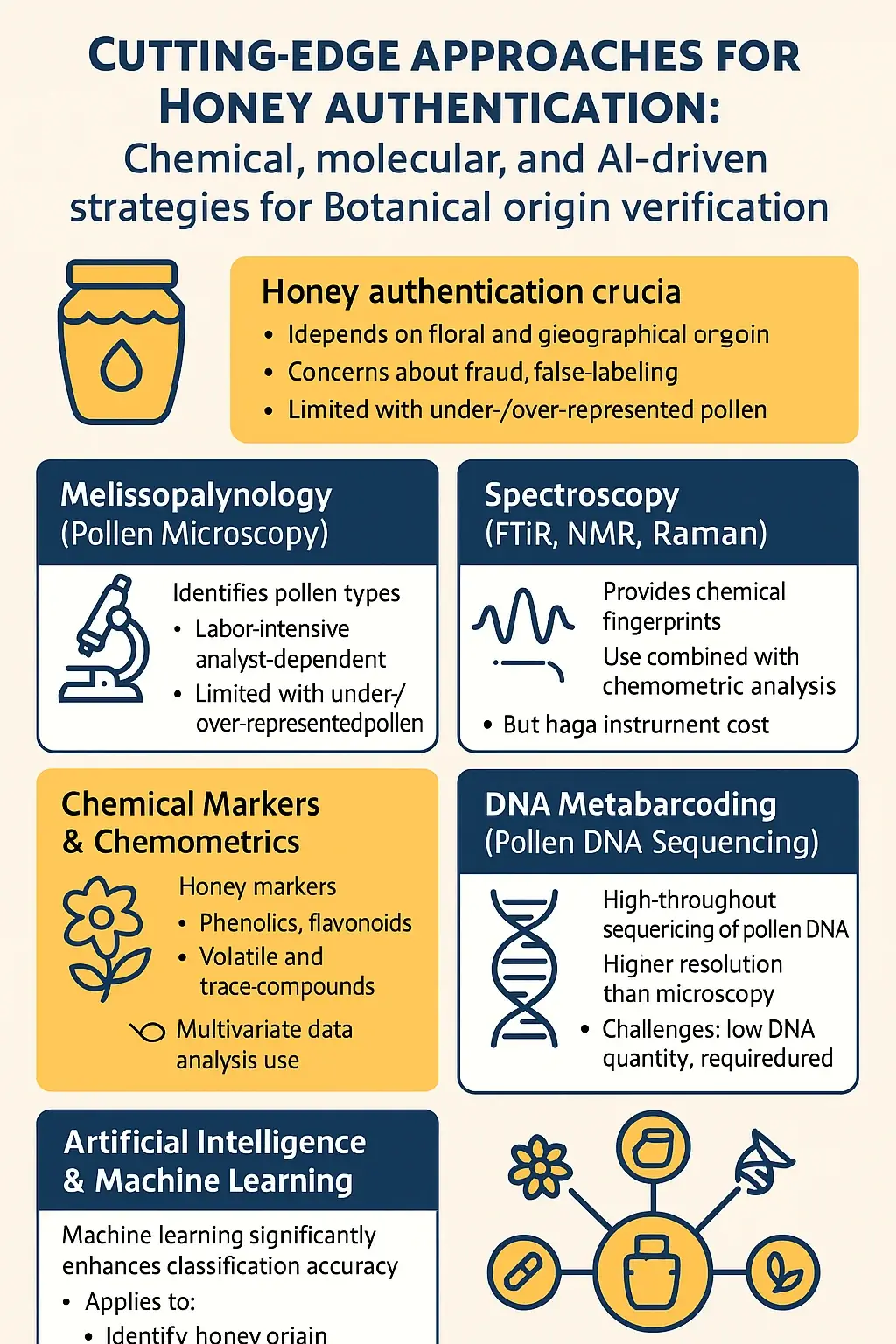
Honey authentication is essential due to the high commercial value of monofloral honeys and the widespread risks of adulteration and false labeling, since honey composition varies with plant species, geography, climate, and environmental conditions.
DNA Barcoding provides a comprehensive overview of the most advanced analytical approaches used to verify botanical origin, ranging from traditional melissopalynology to cutting-edge chemical, molecular, and AI-driven methods. Classical pollen microscopy remains a reference technique but suffers from subjectivity, analyst dependency, and inaccuracies caused by over- or under-represented pollen. Modern tools—including FTIR, NMR, Raman, UV-Vis, and NIR spectroscopy combined with chemometrics; chromatographic and mass spectrometric profiling that identifies unique phenolic, flavonoid, terpene, volatile, and sugar markers; elemental analysis; and high-throughput DNA metabarcoding of pollen using barcodes like ITS2 and rbcL—offer higher sensitivity, specificity, and resolution. AI and machine learning further enhance classification accuracy, enabling automated discrimination of floral origins and adulteration detection through spectral and biochemical signatures. The review highlights challenges such as incomplete reference libraries, limited standardization, high operational costs, and extraction difficulties for DNA-based techniques, emphasizing the need for global databases, harmonized protocols, and affordable tools to make high-precision honey authentication accessible to beekeepers, regulators, and industry stakeholders worldwide.