Authors:Fatma Alzahraa Mokhtar¹*, Seham S. Elhawary², Amal M. Fakhry³, Aseela Abdulla Almoalla⁴, Khawla Mohammed Alyammahi⁵, Youssouf Belaid⁵, Karim Abdelazim⁶, Ahmed Hamdy Zabady⁷, Heba A. Yassin⁸, Hanan M. Elnahas⁹, and Ali El-Keblawy¹⁰,¹¹*
¹ Department of Pharmacognosy, El Saleheya El Gadida University, Egypt² Faculty of Pharmacy, Cairo University, Egypt³ Faculty of Science, Alexandria University, Egypt⁴ Fujairah Environment Authority, UAE⁵ Fujairah Research Centre, UAE⁶ Institute of Graduate Studies and Research, Alexandria University, Egypt⁷ Faculty of Science, Damanhour University, Egypt⁸ Faculty of Pharmacy, Pharos University in Alexandria, Egypt⁹ Faculty of Pharmacy, Zagazig University, Egypt¹⁰ Department of Applied Biology, University of Sharjah, UAE¹¹ Faculty of Pharmacy, Al Salam University, Egypt
Citation: Mokhtar F.A.; Elhawary S.S.; Fakhry A.M.; Almoalla A.A.; Alyammahi K.M.; Belaid Y.; Abdelazim K.; Zabady A.H.; Yassin H.A.; Elnahas H.M.; El-Keblawy A. (2025). Ecological, Apicultural, and Therapeutic Value of Vachellia tortilis and Ziziphus spina-christi Honeys in the United Arab Emirates: A Model for Sustainable Use in Arid Ecosystems. Foods, 14 (16): 2859. https://doi.org/10.3390/foods14162859
Abstract
Honey production in the UAE has deep cultural roots and ecological significance. This review identifies Vachellia tortilis (Samar) and Ziziphus spina-christi (Sidr) as key nectar sources for high-quality Emirati honey. Their honeys are rich in bioactive molecules—flavonoids, peptides, and phenolic acids—endowing them with antioxidant, antimicrobial, and anti-inflammatory power. The plants’ resilience to drought and salinity also supports pollinator conservation, soil fertility, and desert rehabilitation, positioning them as ecological keystones and drivers of sustainable apiculturefoods-14-02859.
1. Introduction
The UAE ranks among global leaders in premium honey quality. V. tortilis and Z. spina-christi honeys exhibit ideal moisture (11–18 %), acidity (6–90 meq/kg), and HMF (< 40 mg/kg), meeting international Codex standards. Their composition—over 60 % reducing sugars, < 20 % water—ensures stability against fermentation.Advanced tools such as DNA barcoding and stable-isotope profiling now certify botanical origin and authenticity, strengthening the UAE’s global honey identityfoods-14-02859.
Both trees provide nectar stability in arid zones, sustaining Apis mellifera jemenitica and A. florea colonies. Their honeys, dense in peptides and antioxidants, rival Manuka in antimicrobial capacity while remaining integral to Emirati heritage and economyfoods-14-02859.
2. Ecological and Cultural Importance
V. tortilis stabilizes dunes, enriches soil carbon, and supports microbial life; Z. spina-christi enhances moisture retention and provides fodder, wood, and shade. These trees sustain biodiversity, pollinators, and climate resilience.Culturally, Samar and Sidr honeys symbolize purity, healing, and hospitality in Bedouin and Islamic tradition—featured in Tibb al-Nabawi and widely used for respiratory, digestive, and wound ailmentsfoods-14-02859.
Their ecological services and social symbolism illustrate how sustainable beekeeping aligns with UAE’s environmental and cultural heritage.
3. Phytochemistry and Bioactivity
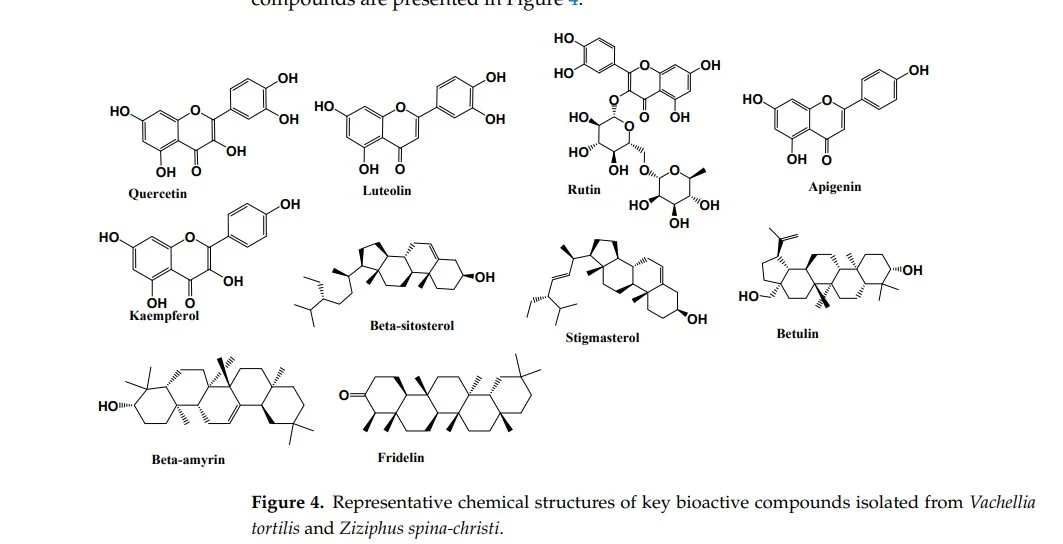
Both species synthesize abundant flavonoids (quercetin, rutin, luteolin, kaempferol) and terpenoids (β-amyrin, betulin, stigmasterol). Phenolic alcohols such as uracol A and B from V. tortilis exhibit antimicrobial potency, while Z. spina-christi produces saponins (christinin-A) and alkaloids with cytotoxic and antioxidant properties.Their transfer into honey confers high total phenolic content—1624–2898 mg GAE/kg (Samar) and 972–1520 mg GAE/kg (Sidr)—explaining their strong antioxidant, antibacterial, and wound-healing activitiesfoods-14-02859.
4. Therapeutic and Pharmacological Insights
V. tortilis extracts showed anxiolytic, antidepressant, and hypolipidemic effects in animal models.
Z. spina-christi extracts demonstrated anticancer and antifungal efficacy (GI₅₀ ≈ 33 µg/mL for HepG2 cells).
Honeys inhibited S. aureus (23 mm zone), E. coli, and C. albicans, comparable to Manuka honey.Their dual-action antimicrobial mechanism—hydrogen-peroxide generation + polyphenol synergy—renders them promising for nutraceutical and clinical usefoods-14-02859.
5. Comparative Quality
Both honeys comply with CODEX benchmarks:
Parameter | V. tortilis | Z. spina-christi | Standard |
Moisture (%) | 14.7 ± 0.5 | 16.9 ± 0.5 | < 20 |
pH | 4.5 | 4.7 | 3.4–6.1 |
HMF (mg/kg) | 0.0 | 1.3 | < 40 |
Fructose + Glucose (%) | 84.9 | 76.9 | > 60 |
Protein (µg/g) | 222 | 561 | — |
UAE Samar and Sidr honeys match or exceed Yemen and Saudi counterparts in phenolic content, confirming their premium grade and pharmacological richnessfoods-14-02859.
6. Sustainability and Innovation
Eco-friendly silver nanoparticles synthesized from Z. spina-christi (ZS-AgNPs) demonstrated antifungal and anti-inflammatory activity, reducing Fusarium infection severity by 75 %. This green-nanotech approach shows potential in both biomedicine and sustainable agriculturefoods-14-02859.
7. Conclusion
The study confirms that Samar and Sidr honeys are not only nutritional assets but also pillars of ecosystem restoration, public health, and cultural continuity.They meet international quality standards, exhibit potent therapeutic effects, and illustrate how indigenous flora and apiculture can coexist within UAE’s sustainability framework.Conservation of V. tortilis and Z. spina-christi ensures future honey resilience, pollinator protection, and community well-being in the face of climate stressfoods-14-02859.
Funding & Acknowledgment
Funding: Fujairah Environment Authority, UAEAcknowledgment: “All authors thank Dr. Fouad Lamghari, Manager of Fujairah Research Centre, for supporting this research.”foods-14-02859
Reference: Mokhtar F.A.; Elhawary S.S.; Fakhry A.M.; Almoalla A.A.; Alyammahi K.M.; Belaid Y.; Abdelazim K.; Zabady A.H.; Yassin H.A.; Elnahas H.M.; El-Keblawy A. (2025). Foods, 14 (16): 2859