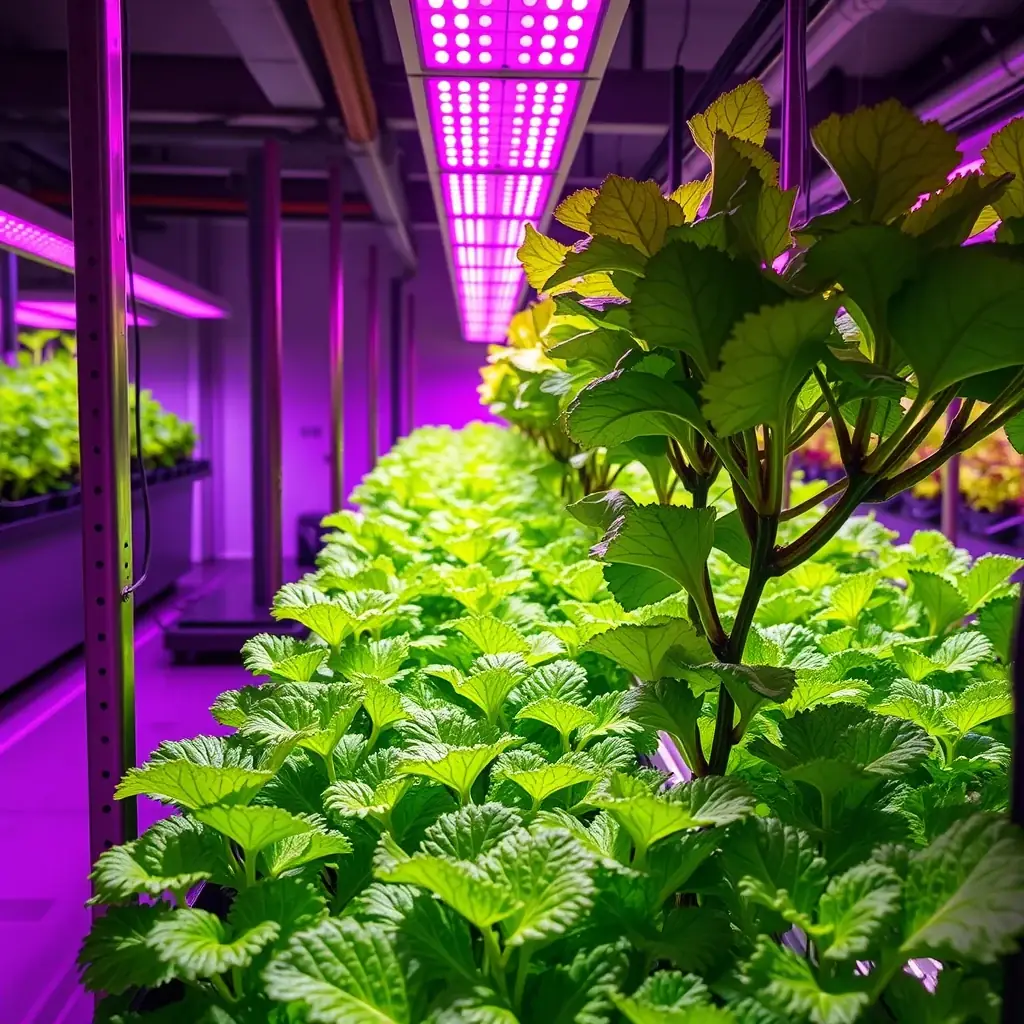
In the pursuit of food security in arid regions, vertical farming has emerged as a groundbreaking solution. However, relocating agriculture indoors eliminates the primary source of plant growth: sunlight. To compensate for this, modern hydroponic facilities not only replicate sunlight but also enhance it. By optimizing the light spectrum in hydroponics, scientists can manipulate plant structure, nutritional content, and growth rates by adjusting the specific wavelengths of light provided to the crops.
Beyond Visible Light: The Power of PAR and Photons
Plants do not "see" light the same way humans do. While we perceive brightness in lumens, plants respond to Photosynthetically Active Radiation (PAR), which encompasses wavelengths between 400 and 700 nanometers. In a vertical farm, the goal is to maximize the Photosynthetic Photon Flux Density (PPFD)—the amount of light that actually reaches the leaf surface—while minimizing energy consumption.
By utilizing Solid-State Lighting (LEDs), researchers can strip away unnecessary wavelengths (such as green light, which is largely reflected by leaves) and focus energy on the "absorption peaks" of chlorophyll a and chlorophyll b. This targeted approach ensures that every watt of electricity used is converted directly into plant biomass, rather than wasted as heat or unusable light.
Tailoring the Spectrum: The "Light Recipe"
The true breakthrough in vertical farming is the development of specific "light recipes." Different stages of plant growth require different spectral compositions. By adjusting the ratio of Red (660nm) to Blue (450nm) light, cultivators can dictate the architecture of the plant:
The Blue Shift: High-energy blue light is essential during the vegetative stage. It inhibits "stretching" (internodal elongation), resulting in shorter, thicker stems and denser leaf clusters. It also plays a critical role in stomatal opening and CO2 exchange.
The Red Shift: Red light is the primary driver of photosynthesis and is vital for flowering and fruit production. However, too much red light alone can cause "shade avoidance syndrome," where plants grow thin and weak.
The Far-Red Influence: Incorporating wavelengths beyond the PAR range, specifically Far-Red (730nm), can trigger the "Emerson Effect," where the combination of red and far-red light increases the overall rate of photosynthesis more than the sum of the two parts alone.
Controlling Secondary Metabolites and Nutrition
Light spectrum optimization extends beyond simply growing plants faster; it can also make them more nutritious. By applying "light stress" at specific intervals, researchers can trigger the production of secondary metabolites. For example, increasing UV-A or Blue light intensity shortly before harvest can stimulate the production of anthocyanins and antioxidants in red-leaf lettuce or boost the essential oil content in herbs like basil.
This manipulation of light in vertical farming enables the production of "functional foods" with specific nutritional profiles tailored to meet consumer needs. Additionally, by removing the seasonal variations caused by sunlight, these systems create a "perpetual spring," ensuring that every harvest is consistent in quality, texture, and flavor.
Thermal Management and Energy Circularity
A major technical challenge in high-density vertical farming is the heat generated by thousands of LED diodes. While LEDs are far more efficient than traditional high-pressure sodium (HPS) lamps, they still release energy as heat. Advanced facilities integrate water-cooling systems into the light fixtures themselves. This heat can be captured and redirected to maintain optimal reservoir temperatures in the hydroponic system or used to dehumidify the air. This level of thermal engineering ensures that the "light-to-biomass" conversion remains the most efficient thermodynamic process possible within the facility.
Frequently Asked Questions
Why do vertical farms often look pink or purple?
This is the result of combining red and blue LEDs. Since plants primarily absorb red and blue wavelengths for photosynthesis and reflect green, using only these colors is highly energy-efficient. However, modern farms are increasingly using "broad-spectrum" white light to allow for better visual inspection of plant health.
Can plants grow faster under artificial light than under the sun?
Yes. In a vertical farm, plants can receive optimal light for up to 18 hours a day without clouds, shade, or seasonal changes. By providing the perfect "light recipe" and constant CO2 levels, some crops can grow up to 50% faster than they would in a traditional field.
What is "PPFD" and why does it matter?
PPFD, or Photosynthetic Photon Flux Density, measures the number of photons of light reaching one square meter of a plant every second. It provides the most accurate assessment of whether a plant is receiving enough energy for growth. In contrast, measurements like "lux" or "lumens" only indicate how bright the light appears to the human eye.