Authors : Fatima Khalfan Saeed Alwali Alkindi, Ali El–Keblawy, Fouad Lamghari Ridouane & Shaher Bano Mirza
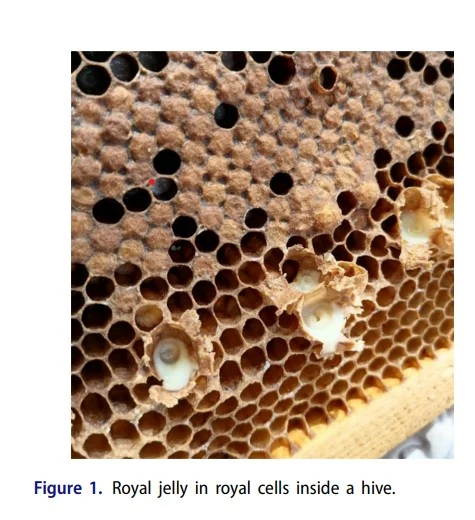
ABSTRACT Royal jelly (RJ) has various applications in cosmetics, health food, and apitherapy to treat chronic inflammation disorders. It is a milky white substance rich in proteins, carbohydrates, lipids, vitamins, and minerals. RJ acts as an antioxidant, anti–inflammatory, and antimicrobial agent, which helps in reducing inflammation and boosting immunity. This review provides an insight into the sensory and chemical analytical aspects of RJ, with a focus on water, 10– hydroxy–2–decenoic acid (10–HDA), protein, and sugar contents, as well as the national and international quality standards of major honey–producing countries. The chemical composition of RJ varies across locations due to external conditions, nectar sources, harvesting conditions, and honeybee species, which affect its quantity and quality. Despite having a consistent composition, the production of RJ per honeybee colony is influenced by environmental conditions, nectar source attributes, and mineral, vitamin, and amino acid content. Advanced analytical methods are required to accurately quantify the diverse ingredients of RJ, which are responsible for its biological and pharmacological effects. Understanding the intricacies of RJ is essential to unlock its therapeutic potential. Notably, apiculture research at the national level acts as sensitive bioindicators, emphasizing the global need for honeybee standards. This exploration contributes to understanding how external factors affect honeybee health and bee product quality.
Executive Summary
Royal Jelly (RJ) is a nutrient-rich secretion produced by honeybees to feed larvae and queens, known for its antioxidant, anti-inflammatory, antimicrobial, and immune-boosting properties. It is widely used in functional foods, cosmetics, and apitherapy, yet its quality and composition vary significantly depending on environmental, biological, and technical factors.
1. Composition and Analytical Standards
RJ is composed mainly of water (60–70%), proteins (11–18%), carbohydrates (7–18%), lipids, vitamins, and minerals. The 10-hydroxy-2-decenoic acid (10-HDA) is a critical bioactive lipid unique to RJ, serving as a global freshness and authenticity marker. ISO and International Honey Commission (IHC) standards classify RJ into Type I (natural nectar-fed) and Type II (artificially-fed) products. However, global standard inconsistencies persist, highlighting the need for harmonized international benchmarks.
2. Key Chemical Indicators
Water Content: Determines shelf life and stability; measured by Karl Fischer titration. Moisture decreases after 72 hours post-grafting, improving quality.
10-HDA: Represents about 70% of RJ’s fatty acids and exhibits antibacterial, antifungal, and anti-inflammatory effects. Its concentration (≥1.4%) is a decisive indicator of purity and therapeutic potential.
Proteins and MRJPs: Major Royal Jelly Proteins (MRJPs 1–10) constitute ~80% of RJ proteins, particularly MRJP1 (royalactin), which drives queen differentiation and offers antioxidant and neuroprotective effects.
Sugars: Mainly fructose, glucose, and sucrose; composition helps detect adulteration or artificial feeding.
3. Environmental and Biological Influences
External factors such as temperature, nectar availability, and pesticide exposure greatly influence RJ’s composition. Urbanization and habitat loss reduce nectar sources, affecting bee health and product yield. Nectar type and floral diversity (e.g., alfalfa, date palm, acacia) alter amino acid and lipid profiles, particularly affecting 10-HDA and MRJP concentrations.
Bee species and genetics also matter—Italian hybrids (Apis mellifera ligustica) produce up to 10× more RJ than local bees. Selective breeding, colony management, and hygienic beekeeping are thus essential for sustainable RJ production.
4. Harvesting and Storage
RJ should be harvested 72 hours post-larval grafting for optimal protein and sugar content. Storage below –18°C preserves nutritional integrity for up to two years, while heat and sunlight rapidly degrade proteins and vitamins. Freeze-drying (lyophilization) extends shelf life while retaining bioactivity.
5. Conclusions and Outlook
The study emphasizes that RJ quality is multifactorial, shaped by bee genetics, floral sources, environment, and harvest management. To ensure global consistency, internationally standardized quality parameters and advanced analytical tools (HPLC, GC–MS, ELISA) are essential.
Adopting scientific beekeeping, genetic selection, and sustainable environmental management will safeguard RJ’s authenticity and therapeutic potential, supporting both bee health and economic resilience of the apiculture industry.
Keywords: Royal Jelly, 10-HDA, Major Royal Jelly Proteins, Apiculture, ISO Standards, Bee Nutrition, Quality Control.