Authors: M.H. Khalifa, A.R. Khirallah, F.I. El-Shahawi, N.A. Mansour and H.K. Abou-Taleb.
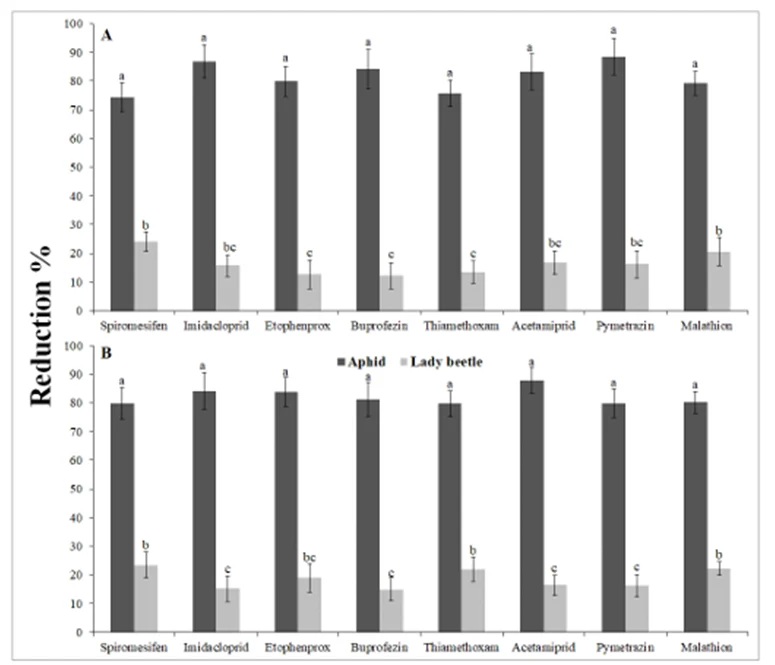
Split-split plot design analysis of residual reduction rates of cotton aphid and lady beetle populations after different insecticides treatments during 2020 (A) and 2021 (B) cotton seasons. Bars of the same color topped by the same letters are not significantly different at P=0.05.
Abstract: To evaluate some insecticide treatments against the adult stage of the cotton aphid, Aphis gossypii Glover (Hemiptera: Aphididae), two field trials were conducted during the cotton seasons of 2020 and 2021 in Abees, Alexandria, Egypt. The negative effects of insecticide treatments against the lady beetle, Coccinella septumpunctata L. larvae were also investigated. The study revealed that, in the 2020 cotton season, the neonictinoid insecticides thiamethoxam, acetamiprid, and imidacloprid, and the organophosphorus insecticide malathion significantly (P ˂ 0.05) exhibited the greatest initial effectiveness against cotton aphid with initial population reduction of 76.8, 76.8, 74.8, and 73.7%, respectively. Thiamethoxam, acetamiprid, imidacloprid, pymetrozine, and malathion had the highest initial cotton aphid population reduction in 2021 of 75.7, 75.4, 75.2, 73.3, and 73.2%, respectively. Pymetrozin, thiamethoxam, malathion, and spiromesifen showed the least residual reduction rates of 81.2, 91.5, 81.6 and 82.5%, respectively. In both seasons, buprofezin significantly (P ˂ 0.05) achieved the least initial toxicity as well as the highest residual toxicity against cotton aphid with reduction rates of 44.8 and 91.9% in 2020 and 52.4 and 87% in 2021, respectively. In addition, other tested insecticides had similar residual toxicity with buprofezin. Whereas, in 2020, imidacloprid and pymetrozin showed residual reduction rates of 89.1 and 91.9%, respectively, whereas in 2021, etophenprox and acetamiprid achieved residual reduction rates of 87.3 and 90.4%, respectively. On the other hand, in 2020, malathion and pymetrozine showed the highest initial toxicity on lady beetle with reduction rates of 27.7 and 25.3%, respectively. Buprofezin also showed in both seasons the least initial side effect against lady beetle and low residual toxicity with reduction rates of 12.1 and 12.2% in 2020 and 15.6 and 14.8% in 2021, respectively. Spiromesifen achieved the highest residual reduction rate (25.6%), significantly followed by malathion (19.2%). Thiamethoxam similar to buprofezin, also achieved the least residual reduction rate against lady beetle (11.4%). In 2021, malathion and spiromesifen showed the highest initial side effects against lady beetle with reduction rates of 26.8 and 26.6%, respectively. Spiromesifen, thiamethoxam, and malathion gave the highest residual toxicity with reduction rates of 22.8, 21.7 and 21.4%, respectively. According to the IOBC classification, all insecticide treatments were considered harmless against lady beetle, where the reduction rates were less than 50% in the field. The good selectivity feature of these insecticides makes them suitable components for IPM programs against cotton aphids.
Reference: V422-Pages-208-214-MS-27-23.pdf.