Authors : AishahAl Dhanhani1, FrançoisTsombou1, Shaher Mirza1, Suzan Shahin2 & Fouad Ridouane1
Study Overview
This research, led by Aishah Al Dhanhani, François Tsombou, Shaher Mirza, Suzan Shahin, and Fouad Ridouane, represents the first scientific investigation of Morus nigra (native) and Morus alba (exotic) species grown under UAE environmental conditions, particularly in Fujairah.The study aimed to:
Characterize mineral, nutrient, and phytochemical profiles of different plant parts (leaves, branches, roots).
Assess antibacterial and antifungal properties of both species against common pathogens.
The research used standard AOAC and ISO methods, including flame photometry, ICP–AES, UV-Vis spectrophotometry, Soxhlet extraction, and the disk diffusion method for antimicrobial activity. Statistical analysis was conducted via two-way ANOVA and Tukey’s test.
Key Findings: Mineral and Nutrient Profiles
Significant differences (p < 0.001) were found between the two species and across plant parts:
Morus nigra (native):
High in macronutrients Ca (1514 mg/100 g), K (1182 mg/100 g), Mg (454 mg/100 g), P (398 mg/100 g).
Strong levels of micronutrients Mn (2.07 mg/100 g) and Ni (1.36 mg/100 g).
Leaves were rich in Ca and K; roots concentrated Mg, P, Na, Ni.
No detectable Se, Cd, or Pb → safe for consumption.
Morus alba (exotic):
Rich in Cu (1.08 mg/100 g) and Zn (1.58 mg/100 g)—both exceeding daily dietary requirements.
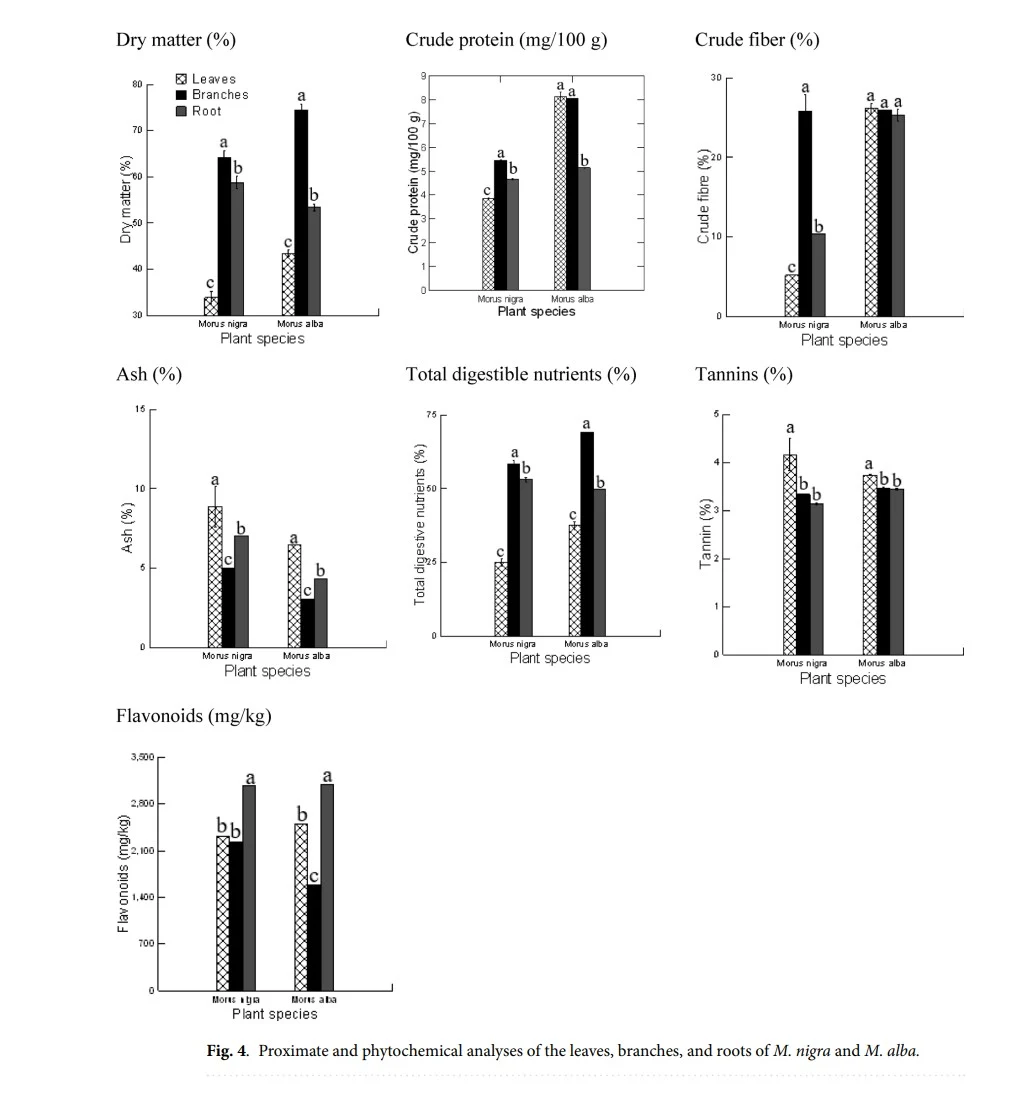
Exhibited higher dry-matter (74.45%), crude protein (8.14 g/100 g), crude fiber (25.97%), and flavonoid content (3089 mg/kg).
These results confirm the adaptability and nutritional robustness of both species under Fujairah’s arid climate.M. nigra excels in mineral density (Ca, Mg, P, Na, Ni), while M. alba shows superior nutrient and flavonoid composition, explaining its higher biological activity and potential invasiveness.
Phytochemical Composition
M. nigra: High ash (8.77%) and tannins (4.16%), contributing to its traditional medicinal use.
M. alba: Elevated flavonoids, dry matter, and protein levels. Phenolic compounds were below detectable limits.
Low crude fat (< 0.1%) was observed in both species.
Antimicrobial Activity
Extracts from different plant parts (leaves, branches, roots) were tested against:
Bacteria: Staphylococcus aureus, Bacillus cereus, Escherichia coli, Clostridium botulinum.
Fungi: Aspergillus flavus, Candida albicans.
Results showed that antibacterial effects exceeded antifungal effects, with roots > branches > leaves in potency.
Morus alba (exotic)
Exhibited the strongest antimicrobial activity, notably from root extracts:
S. aureus 32.66 mm, E. coli 32.66 mm, B. cereus 31.66 mm, C. albicans 24.66 mm.
Strong correlations between flavonoid content and antibacterial activity, particularly against S. aureus, E. coli, and C. botulinum.
Morus nigra (native)
Also showed potent antibacterial activity though slightly lower:
E. coli 30.33 mm, S. aureus 29.33 mm, B. cereus 29.33 mm, C. albicans 21.66 mm.
Tannins were identified as key contributors to antimicrobial properties.
Overall, both species outperformed prior studies where inhibition zones were under 20 mm, underscoring the exceptional bioactivity of UAE-grown mulberries.
Discussion and Implications
M. nigra is an excellent calcium-rich food source, useful for bone health, while M. alba offers superior flavonoid-based antimicrobial potential.
The absence of toxic heavy metals highlights both as safe for nutraceutical and pharmaceutical use.
Their bioactive compounds (flavonoids + tannins) provide natural solutions to the global issue of antimicrobial resistance.
Beyond healthcare, their properties make them suitable for food preservation, cosmetics, agriculture (biopesticides), and animal feed.
Conclusion
The research confirms:
Distinct chemical and biological profiles between native and exotic Morus species.
Morus alba demonstrates the highest antimicrobial potential, while Morus nigra shows richer mineral and ash content.
Both are non-toxic, nutritionally valuable, and pharmacologically promising, contributing to the UAE’s biodiversity-driven sustainable development and bio-innovation goals.
Future work should include seasonal, in vivo, and clinical studies to validate therapeutic efficacy and optimize their integration into food, pharmaceutical, and environmental applications.