Authors: P. Subraelu, A. Ahmed, A.A. Ebraheem, M. Sherif, S.B. Mirza, F.L. Ridouane, and A. Sefelnasr
Journal: Water, 2023, 15(15), 2802
Affiliations: United Arab Emirates University (UAEU) and Fujairah Research Centre
Abstract
Flash floods are among the most frequent and destructive natural hazards in arid regions, threatening lives, infrastructure, and economic activity. In Fujairah City — a rapidly urbanizing coastal area bordered by seven wadis — this study integrates remote sensing and GIS-based weighted overlay analysis to map Flash Flood Vulnerable Zones (FFVZ).Eight parameters derived from satellite and field data were analyzed: rainfall, elevation, slope, drainage density, land use/land cover (LULC), geology, geomorphology, and soil.
Results reveal that:
55 km² are very highly vulnerable,
78 km² are high risk,
9.3 km² are moderate,
70 km² are low, and
257 km² are very low vulnerability areas.
Highly exposed sites include Fujairah Airport, Fujairah Port, oil storage zones, residential districts, hospitals, and universities. The findings support decision-makers in urban planning, flood mitigation, and infrastructure protection.
1. Background
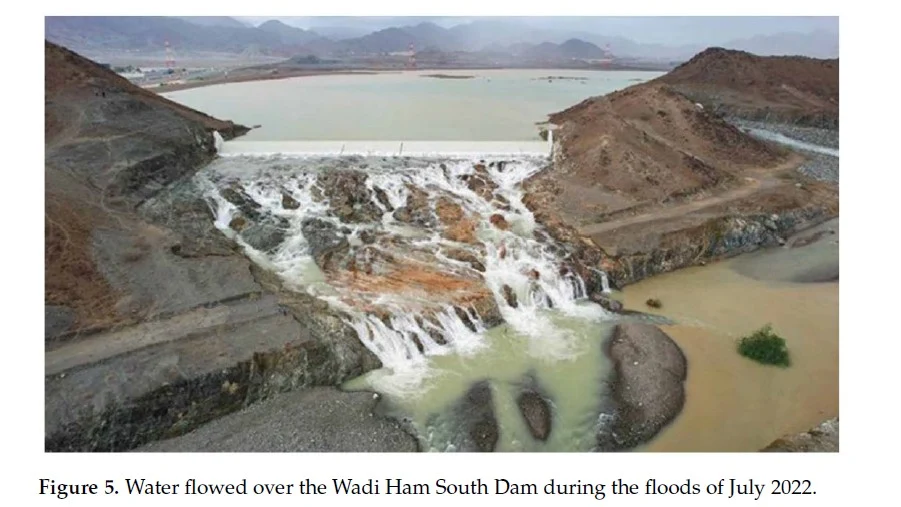
Flash floods in arid environments like the UAE occur when short, intense rainfall overwhelms dry valleys (wadis). Events have become more frequent due to climate change, cloud-seeding effects, and rapid urbanization.The UAE’s eastern coast, especially Fujairah, has recorded 13 major flood events in the past two decades. The catastrophic July 2022 floods saw 234.9 mm of rainfall at Fujairah Port, forcing the evacuation of over 4,000 residents and causing widespread infrastructure damage.
Despite mitigation structures — including two main dams and fifteen breaker dams — low-lying urban zones remain highly exposed. The study responds to this urgent need for a data-driven flood-risk map to inform future land-use planning and emergency management.
2. Study Area
Fujairah Emirate spans 1,450 km², of which Fujairah City occupies ~560 km² along the Gulf of Oman. The Hajar Mountains (elev. up to 1,103 m) dominate the west, feeding seven wadis — Hayl, Saham, Farfar, Ham, Yabsah, Madhab, and Safad — that converge toward the coastal plain.About 77 % of the emirate’s 318,000 residents live within the city’s low-elevation zones (< 50 m a.s.l.), where urban sprawl expanded from 40 km² (1990) to 115 km² (2023). This urbanization, combined with impermeable surfaces, intensifies runoff and flood exposure.
3. Methodology
A GIS multi-criteria evaluation integrated eight thematic layers:
Rainfall: CHRS RainSphere data (2000–2022; 80–325 mm/year)
Topography: SRTM DEM (30 m) → elevation & slope maps
Drainage Density: derived from DEM hydrology
LULC: Landsat (1990–2010) & Sentinel-2 (2023; 20 m resolution)
Geology & Geomorphology: interpreted from Sentinel-2 and prior UAE geological maps
Soil: UAE Soil Museum data
Each layer was classified, ranked (1–5), and weighted (8–18 %) according to influence on flood behavior. Weighted overlay in ArcGIS 10.4 produced a composite FFVZ map distinguishing very low to very high-risk zones.
4. Key Findings
Rainfall: Most intense between Oct and Apr; > 160 mm falls on mountainous catchments feeding urban wadis.
Elevation/Slope: Built-up zones below 50 m with < 5 % slope exhibit highest flood risk.
Drainage Density: Low-density areas near coastal plains show poor runoff capacity.
LULC: Residential, commercial, port, airport, and oil storage facilities assigned highest risk rank (5).
Geology/Soil: Coastal alluvium and saline Aquisalids have low infiltration → high runoff; mountain zones with igneous rocks ranked low risk.
Overall, 28 % of the area falls under high to very high vulnerability, aligning with zones damaged during the 2022 flood.
5. Discussion
The model confirms that urban expansion into flood-prone wadis, combined with increasing rainfall intensity, amplifies flood hazards. The weighted overlay approach effectively integrates multi-thematic parameters for spatial prioritization. Results corroborate prior regional assessments [32, 64, 109–112], validating GIS-based methods for climate adaptation and land-use regulation.
Authors recommend:
Enforcement of flood-zoning laws in low-lying coastal areas.
Integration of real-time rainfall and runoff sensors for predictive monitoring.
Expansion of rainwater harvesting and recharge dams to mitigate future events.
6. Conclusion
This comprehensive geospatial analysis identifies Fujairah City’s critical flash-flood hotspots and demonstrates the utility of remote sensing + GIS for urban hazard mapping in arid regions.By quantifying terrain, rainfall, and land-use factors, the study supports UAE authorities in risk-aware urban development and resilient infrastructure planning.The methodology can be replicated for other wadi-dominated cities across the Gulf to strengthen regional flood resilience.
References
Getahun & Gebre (2015) – Flood risk mapping in Awash River basin, Ethiopia.
Mathew Kelly (2019) – Flood risk assessment in Hawkesbury-Nepean Catchment, Australia.
Bullard & Livingstone (2002) – Aeolian and fluvial interactions in arid geomorphology.
Pain C.F. et al. (2014) – Geomorphology of arid lands.
Subraelu P. et al. (2023) – Risk Assessment and Mapping of Flash Flood Vulnerable Zones in Arid Region, Fujairah City, UAE — Water 15, 2802. MDPI.
Citation:Subraelu P., Ahmed A., Ebraheem A.A., Sherif M., Mirza S.B., Ridouane F.L., Sefelnasr A. (2023). Risk Assessment and Mapping of Flash Flood Vulnerable Zones in Arid Region, Fujairah City, UAE — Using Remote Sensing and GIS-Based Analysis. Water, 15(15): 2802.
https://doi.org/10.3390/w15152802 water-15-02802-v3