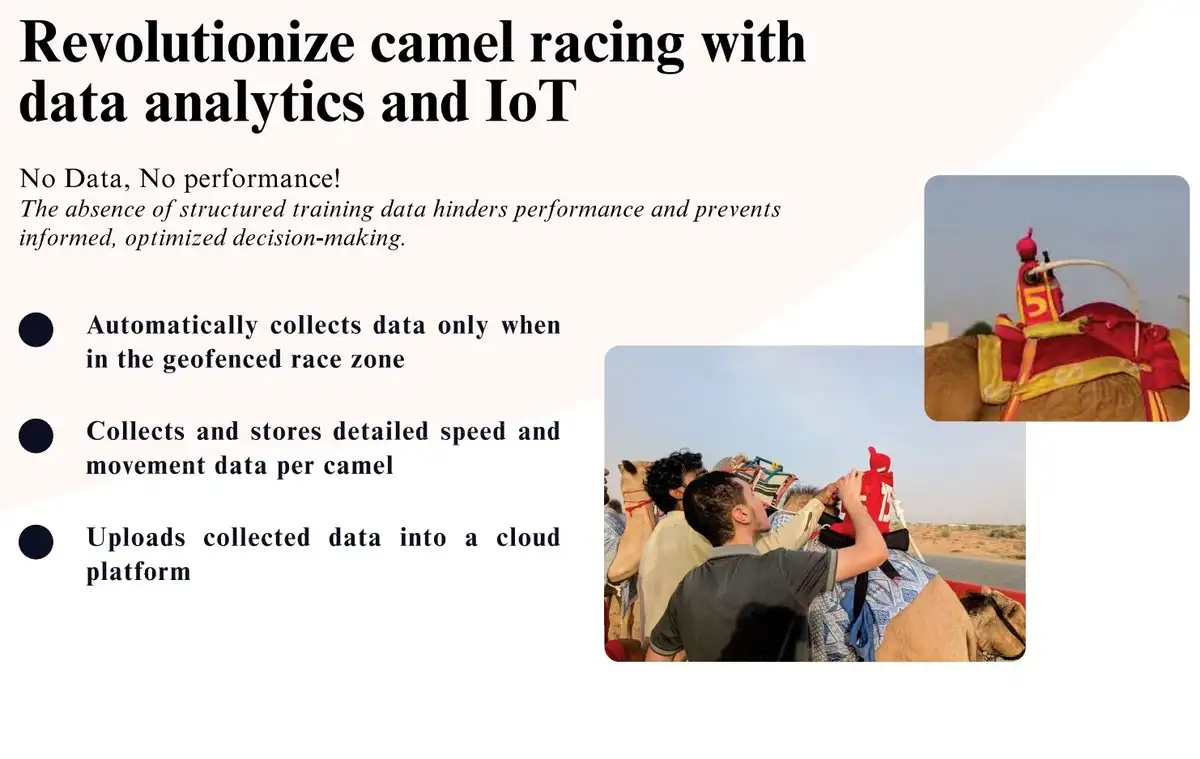
For generations, camel training records have depended on subjective impressions. One trainer might document a training session, while another relies on intuitive memory. Notes may be brief, incomplete, or influenced by personal judgment. When trainers change or multiple handlers share responsibilities, the historical context becomes fragmented. A camel’s development story disappears, leaving new trainers guessing about past performance, weaknesses, or previous stress patterns.
This absence of structured, consistent data leads to several problems:
Training programs cannot be scientifically optimized
Long-term trends (good or bad) are impossible to measure
Recurring micro-problems go unnoticed across seasons
Camels with high potential may be overlooked
Regression or plateaus appear without explanation
IoT and AI resolve this permanently.The system automatically creates a continuous digital timeline for each camel:
Every run is measured, stored, and compared
Every performance metric becomes part of a long-term profile
Year-to-year readiness is tracked with precision
Trainer transitions no longer break the data continuity
This history becomes a strategic asset. With full visibility, trainers can see how a camel responded to different intensities, surfaces, and weather conditions. They can detect patterns that human observation alone could never capture. And they can design modern, evidence-based training programs tailored to each camel’s physiological signature. Data turns training from art into science.