Authors: Soumya Koippully Manikandan, Dharshini Jenifer. A, Nisarga K. Gowda, Vaishakh Nair, Rami Al-Ruzouq, Mohamed Barakat A. Gibril, Fouad Lamghari, John Klironomos, Maryam Al Hmoudi, Mohamed Sheteiwy, Ali El-Keblawy.
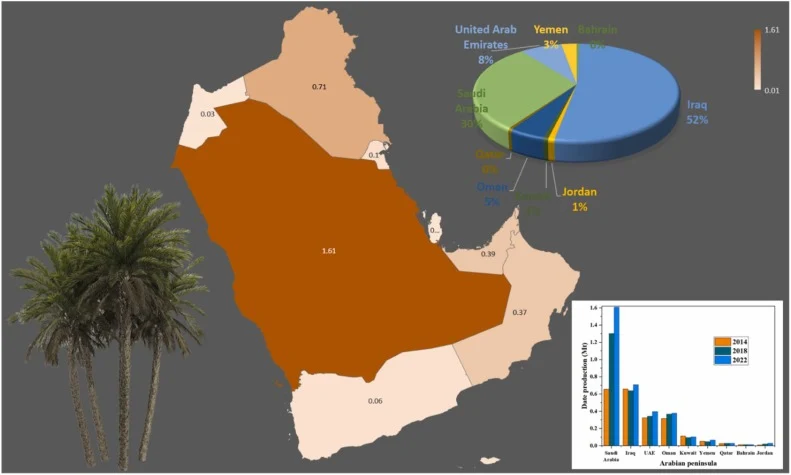
Date palm production in the Arabian Peninsula: (a) distribution of production by country (Mt), (b) harvested area as percentage of total area, and (c) trends in date production for 2014, 2018, and 2022, supporting advances in stress tolerance, genetic diversity, and sustainable cultivation.
Abstract: Date palm (Phoenix dactylifera L.) cultivation in the Arabian Peninsula is crucial for regional agriculture and global markets. The Arabian Peninsula is dominant in date production, contributing approximately 34 % of the global output. Recent advancements in agricultural technologies have improved fruit yield and quality, expanding date palm cultivation globally. However, sustainability challenges persist due to various abiotic stresses, such as salinity, temperature extremes, drought, soil factors, and biotic stresses, including diseases and pests. This review examines key environmental factors affecting date palm cultivation, with a focus on soil salinity, water scarcity, and climate change-related stresses. The genetic diversity among date palm varieties is emphasized, highlighting the need for breeding programs aimed at improving stress tolerance and yield. Biotechnological advancements, such as genetic transformation and genome editing, are discussed for their potential to enhance crop resilience and productivity. Additionally, remote sensing techniques are explored for their application in precision agriculture, particularly in the mapping and monitoring of date palm health and soil conditions. The significant role of artificial intelligence in accurately mapping date palm trees using multi-platform remotely sensed data is also reviewed, illustrating its potential to enhance geospatial databases and support sustainable management practices. The review concludes with recommendations for optimizing cultivar selection and management strategies tailored to local conditions, emphasizing the need for ongoing research to advance date palm cultivation on a global scale.