Authors: Nabil Mansour, Ahmed G. Ismail, Sabhah Alhmoudi, Fouad Lamghari.
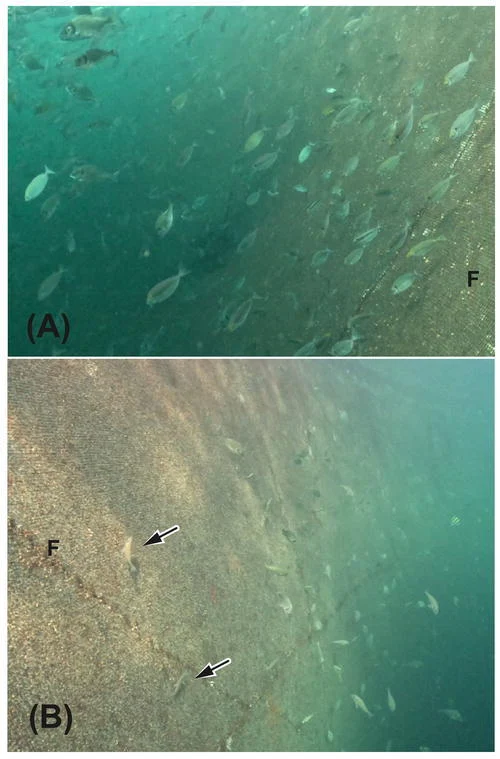
Net biofouling and net-biting behavior of 174 days old seabream fish reared in (A) polyculture cages with rabbitfish and (B) monoculture cages. F: Net biofouling; Arrows: shows the net-biting behavior.
Abstract:
Introduction: White-spotted rabbitfish (Siganus canaliculatus), an herbivorous species that grazes on algae and seaweed, contributes significantly to ecosystem balance by controlling algal blooms and enhancing water quality. This ecological function makes it a valuable companion species in polyculture with carnivorous gilthead seabream (Sparus aurata). Accordingly, the present study investigated the integration of rabbitfish into offshore seabream farming systems under tropical aquaculture conditions, with an emphasis on growth performance, biofouling mitigation, and resilience against Enteromyxum leei infection. Methods: Experiments were conducted over two full production cycles in open-sea cages in the United Arab Emirates. Six cages were assigned to seabream monoculture and six to polyculture with rabbitfish. Key performance indicators including growth rate (GR), specific growth rate (SGR), feed conversion ratio (FCR), mortality, biofouling biomass, annelid abundance, seabream biting behavior, and E. leei infection prevalence and severity were assessed using area under the curve (AUC) analysis.
Results: Polyculture significantly improved seabream performance compared to monoculture. Mortality was lower (4.7% vs. 8.4%), FCR and feeding rate were reduced, and both GR and SGR were higher in polyculture. Net fouling biomass (220.3 g/m2 vs. 260.2 g/m2), annelid abundance (74.4 vs. 90.8 individuals/m3), and biting frequency (34.1 vs. 42.6 bites/100 fish/h) were also reduced in polyculture. E. leei prevalence and severity peaked at 29.4% and degree 2.5 in polyculture compared to 49.8% and degree 4.0 in monoculture. Infections were undetected in both systems from July to October, aligning with seawater temperatures exceeding 31.8°C. Net replacement intervals were nearly doubled in polyculture (344 vs. 196 days). Conclusions: Integrating rabbitfish into gilthead seabream cages can improve growth efficiency, reduce parasite load, minimize net fouling, and enhance overall system sustainability, making it a promising strategy for tropical offshore aquaculture.