Authors: Fawaghy Alhashmi, Nabil Mansour, Shaher Bano Mirza, Fouad Lamghari.
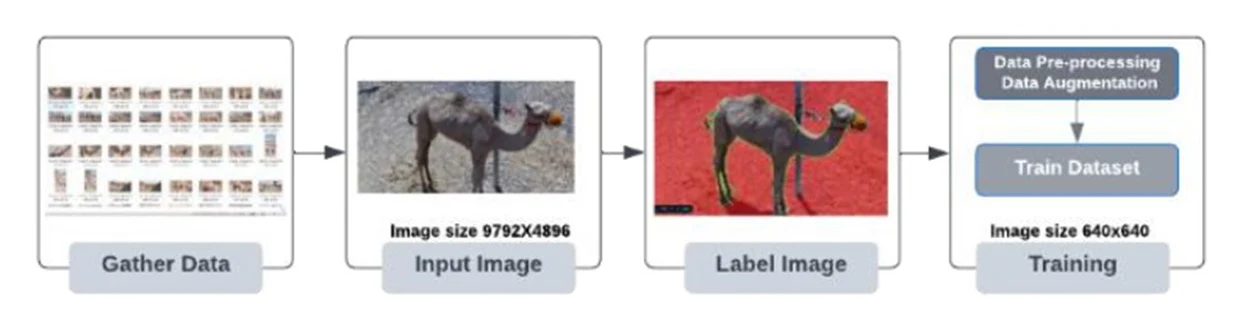
The manual labeling and training process for YOLOv7
Abstract:
Background: Dermatophytosis, commonly known as ringworm, is a contagious fungal skin disease prevalent among camels, particularly of 1-3 years old, and resulting in considerable economic losses. Recently, using machine learning technology presents a promising avenue for achieving high diagnostic accuracy, especially in identifying infected camels in remote farm settings.
Methods: A dataset comprising 801 images from 61 camels aged 12-15 months was subjected to analysis using YOLOv7 (You Only Look Once, volume 7), a Machine learning model. Subsequently, the YOLOv7 algorithm's efficacy in distinguishing between healthy and ringworm-infected camels was evaluated.
Results: The YOLOv7 algorithm demonstrated robust capability in accurately identifying ringworm-infected skin and distinguishing it from healthy skin in camels. Validation set results revealed an average precision (AP) of 0.944, indicating high effectiveness in discriminating between normal and infected skin. Furthermore, the algorithm exhibited proficiency in classifying the severity of skin infection among the identified cases. Of the 61 camels analyzed, 36 were found to be infected, representing an incidence rate of 59%. These infected camels were further categorized into groups based on the severity of infection, with 6 classifieds as mild (<50 infection spots), 5 as moderate (50-100 spots), and 25 as severe (>100 spots).
Conclusion: The YOLOv7 model emerges as a dependable tool for the identification and classification of camel ringworm infections. Its implementation incorporated in farm surveillance and notification system holds promise for early detection of such issues and effective monitoring of camels kept under farm conditions in remote areas.