Authors: Maryam Alhefeiti, Shaher Bano Mirza, Fouad Lamghari Ridouane.
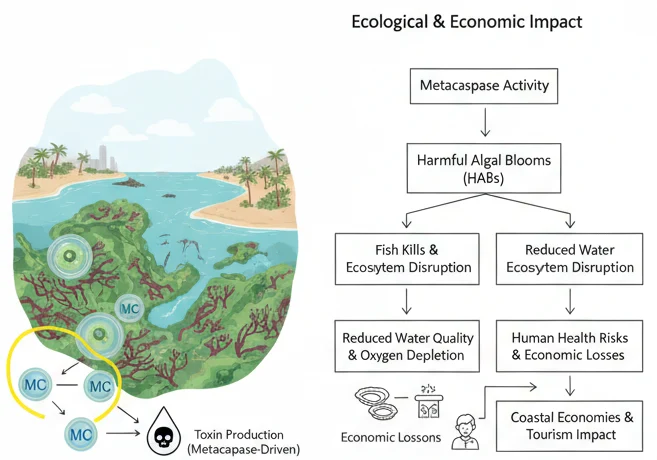
Abstract: Harmful algal blooms (HABs) pose significant threats to aquatic ecosystems, human health, and coastal economies worldwide. The causative agents of HABs are primarily dinoflagellates Marglefidiniumpolykrikoides and Prorocentrum minimum), and diatoms (Chaetocerostenuissimus, Fragilaria radians, Phaeodactylumtricornutum, and Skeletonemamarinoi), which produce various toxins that exacerbate the harmful effects. Metacaspase, a toxin-producing protein, has emerged as a critical component in the pathogenesis of HABs. This study aims to investigate the evolutionary relationships among diatoms and dinoflagellates based on the metacaspase protein. The analysis based on sequence clustering, indicates that the dinoflagellates anddiatoms share common ancestors where Marglefidiniumpolykrikoides and Prorocentrum minimum are evolutionarily closer to diatom Skeletonemamarinoi. This study prepares the base to further explore their involvement in HABs, elucidate the production of metacaspase by specific diatom and dinoflagellate species, and investigate the role of metacaspase in the toxicity of HABs.