Authors: Aishah Saeed Sulaiman Jemei Al Dhanhani, Shaher Bano Mirza*, Fatmah Rashed Mohamed Obaid Alhefeiti, Fouad Lamghari Ridouane.
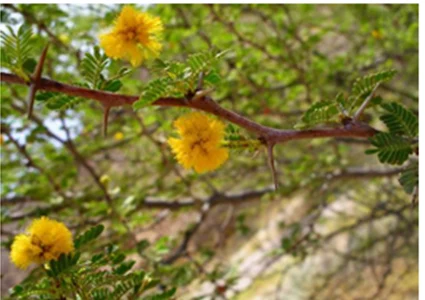
Flower and leaves of Acacia ehrenbergiana tree
Abstract:
Background: Acacia ehrenbergiana and Acacia tortilis are native plants of the Emirate of Fujairah, UAE. The qualities of these plants to bear harsh environmental conditions make them a prime focus for native fodder plants for Arabian tahr and priority plants for the higher authorities in Fujairah.
Methods: The following study assessed the comparative nutritional value of Acacia tortilis and Acacia ehrenbergiana. The analyses have been determined by international standard procedures using Gravimetry, Soxhlet extraction, HPLC, and ICP-OES (AOAC 962.09, AOAC 941.12). The vegetation mapping for the blooming period has been done by NDVI using data from Sentinel-2 satellite. Statistics of agricultural and non-agriculture areas in square kilometers (km2) have been found to confirm the findings of the NDVI using satellite images.
Results: The study has highlighted the importance of these native plants as a fodder plant for Arabian tahr as potential sources of potassium, calcium, magnesium, and phosphorus. Furthermore, the native plant's mapping showed Emirates of Fujairah's vegetation during March to May 2022.
Conclusion: Results show that the A. ehrenbergiana is comparatively healthier diet for Arabian Tahr than Acacia tortilis. Tahr can get on average 400 mg/100 g of four important minerals including K, Ca, P and Mg while Acacia tortilis could provide 174 mg/100g. Moreover, the native plant’s vegetation mapping can work as blueprint and will help identify plant dispersion and expansion planning.
Reference: