Authors: Aishah Al Dhanhani, François Tsombou, Shaher Mirza, Suzan Shahin & Fouad Ridouane.
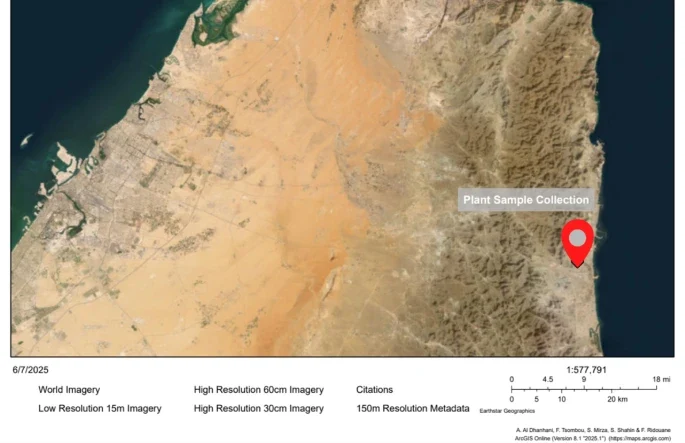
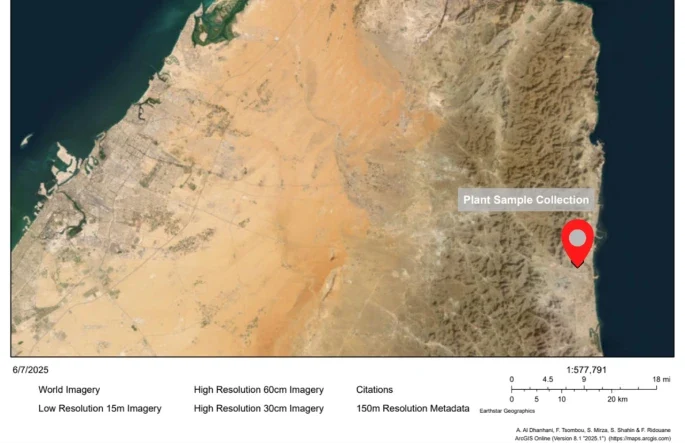
Location of plant sample collection as indicated by ArcGIS Online (Version 8.1 “2025, 1”).
Abstract: Mulberry (Morus species) is a well-known economic crop that has served as an effective natural remedy in various traditional therapeutic practices, including the folk medicine of the United Arab Emirates (UAE). Despite this fact, no research has been done to explore the chemical composition and antimicrobial activity of Morus species grown in the UAE. Therefore, the main objective of this study is to evaluate the mineral content, phytochemical analyses, antifungal and antibacterial properties (for leaves, branches, and roots) of the only mulberry species present in the United Arab Emirates (UAE); Morus nigra (native) and Morus alba (exotic), both of which can be found within the wild flora of Fujairah. The study hypothesized that there are significant differences between the two tested species in terms of mineral content, nutrient levels, phytochemical profiles, and antimicrobial properties. Mineral content analyses for Sodium (Na), Potassium (K), Magnesium (Mg), Phosphorus (P), Calcium (Ca), Manganese (Mn), Zinc (Zn), Nickel (Ni), Copper (Cu), and Selenium (Se) were extracted via acid digestion, followed by flame photometry and atomic absorption spectrophotometry, referencing Association of Official Analytical Chemists (AOAC) methods. Heavy metals, specifically Cadmium (Cd) and Lead (Pb), were analyzed using inductively coupled plasma atomic emission spectroscopy (ICP‒AES). Nutritional components such as dry matter, crude protein, crude fiber, crude fat, ash, total digestible nutrients (TDN), tannins, total phenols, and flavonoids were quantified using various standard methodologies, including oven drying, Soxhlet extraction, and Ultraviolet–Visible Spectrophotometry (UV–Vis spectrophotometry). Antimicrobial activities were assessed through the Disk Diffusion Method against selected bacterial strains (Staphylococcus aureus, Bacillus cereus, Escherichia coli, and Clostridium botulinum) and fungal strains (Aspergillus flavus, Candida albicans), with inhibition zones measured post-incubation. The experiment included statistical analyses using two-way Analysis of Variance (ANOVA), Tukey’s test, and SYSTAT software. This study revealed a significant difference between M. nigra (native) and M. alba (exotic), in terms of the studies parameters. The investigation demonstrated that M. nigra exhibited substantial mineral content for key macronutrients, specifically Ca, K, Mg, and P, as well as elevated levels of the secondary macronutrient Na and significant concentrations of micronutrients Mn and Ni. The leaves of M. nigra were characterized by particularly high Ca content, measuring 1514.01 mg/100 g, which exceeds daily calcium requirements and significantly surpasses levels reported in previous studies. Meanwhile, the roots displayed rich concentrations of Mg, P, Na, and Ni, with levels of 454.18, 398.67, 183.54, and 1.36 mg/100 g, respectively. Similarly, M. alba also demonstrated considerable mineral content, particularly in Cu and Zn. Notably, the leaves contained high levels of Cu, at 1.08 mg/100 g, which exceeds daily dietary requirements, while the branches were rich in Zn, with a concentration of 1.58 mg/100 g. Notably, both species tested showed no detectable levels of Se and the heavy metals Cd and Pb, underscoring their potential safety for consumption. Phytochemical analyses revealed that the leaves of M. nigra exhibited elevated ash content (8.77%) and tannin levels (4.16%). In contrast, M. alba demonstrated superior nutritional qualities, including a higher dry matter content (74.45% from branches), protein levels (8.14 g/100 g from leaves), crude fiber content (25.97% from leaves), total digestible nutrients (TDN) (69.18% from branches), and flavonoid concentrations (3089.32 mg/kg from roots). While the analysis revealed low crude fat levels and undetectable phenolic content. Notably, M. alba demonstrated superior antimicrobial effects, attributed to its flavonoid content, with roots exhibiting the strongest activity. It was observed that antibacterial activities exceeded antifungal activities, with a maximum inhibition zone of 32.66 mm recorded for S. aureus, compared to 24.66 mm for C. albicans. These findings highlight the rich chemical composition and significant antimicrobial potential of both species, underscoring their value in traditional uses and potential for sustainable applications in the pharmaceutical and nutritional industries.