Authors: Walaa A. Negm, Engy Elekhnawy, Fatma A. Mokhtar, Reem Binsuwaidan, Nashwah G.M. Attallah, Sally Abdallah Mostafa, Ehssan Moglad, Sarah Ibrahim, Omnia Momtaz Al-Fakhrany, Duaa Eliwa.
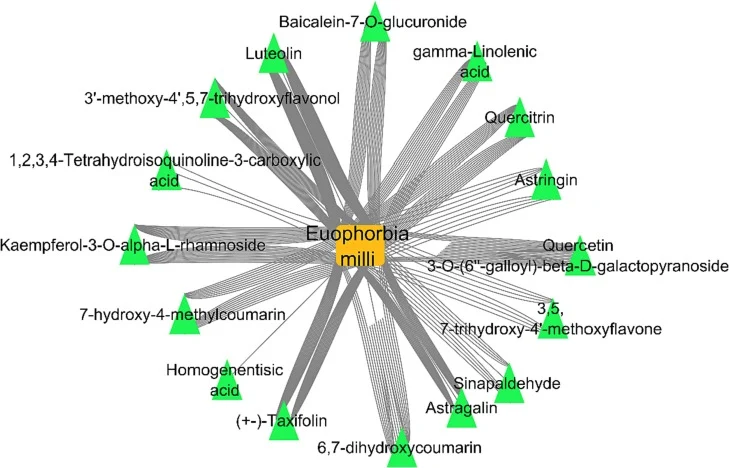
Plant–metabolite network of Euphorbia milii Des Moul., showing the plant node linked to its identified phytochemical metabolites used to explore anti‑inflammatory potential through a network pharmacology approach.
Abstract: The inflammatory reaction is induced by several factors like stimulation of different enzymes, oxidative stress, and production of various proinflammatory mediators. Here, we elucidated the phytochemical profile of Euphorbia milii ethanol extract (EMEE) then, we studied its anti-inflammatory potential using a carrageenan-induced paw edema model in rats. It was found that the average paw edoema weight substantially declined (p < 0.05) by treatment with EMEE (100 mg/kg and 200 mg/kg). Also, it was noticed the immunostaining with cyclooxygenase-2 and tumor necrosis factor-alpha antibodies decreased to a mild positive (score 1) after treatment with EMEE (200 mg/kg). This is along with improvement in the histological findings after examination of the paw tissues with hematoxylin and eosin as it revealed a decrease in the inflammation. Also, EMEE (200 mg/kg) resulted in a significant decline (p < 0.05) in the levels of the proinflammatory mediators (granulocyte–macrophage colony-stimulating factor, monocyte chemoattractant protein-1, inducible nitric oxide synthase, and interleukin-5). Interestingly, it resulted in a substantial increase (p < 0.05) in the levels of the anti-inflammatory interleukins (IL-10 and IL-12). Using the Swiss Target Prediction database, 127 genes were related to the identified metabolites in EMEE, of which 55 target genes were associated with 11 inflammatory disorders, as demonstrated by the DisGeNET database. The PI3K-Akt signaling route, the MAPK signaling pathway, and the Ras signaling pathway were identified as the dominant signaling pathways by the study of annotated genes. Therefore, EMEE requires further clinical investigations as an anti-inflammatory agent.