Limited Ability to Measure Real Performance During Training
In traditional camel training, most performance assessment is based on what the eye can catch. Trainers estimate speed, guess acceleration, and rely on their memory to compare today’s run with last week’s. But reality is harsher:
You cannot improve what you cannot measure.
Without precise numbers, a trainer is forced to rely on:
Rough speed estimates
General impression of effort
Memory-based comparisons
Trial-and-error decisions
Feedback that comes too late
And while this method has worked for generations, it comes with real limitations—especially when milliseconds decide the winner.
🚀 How IoT + AI Change the Game
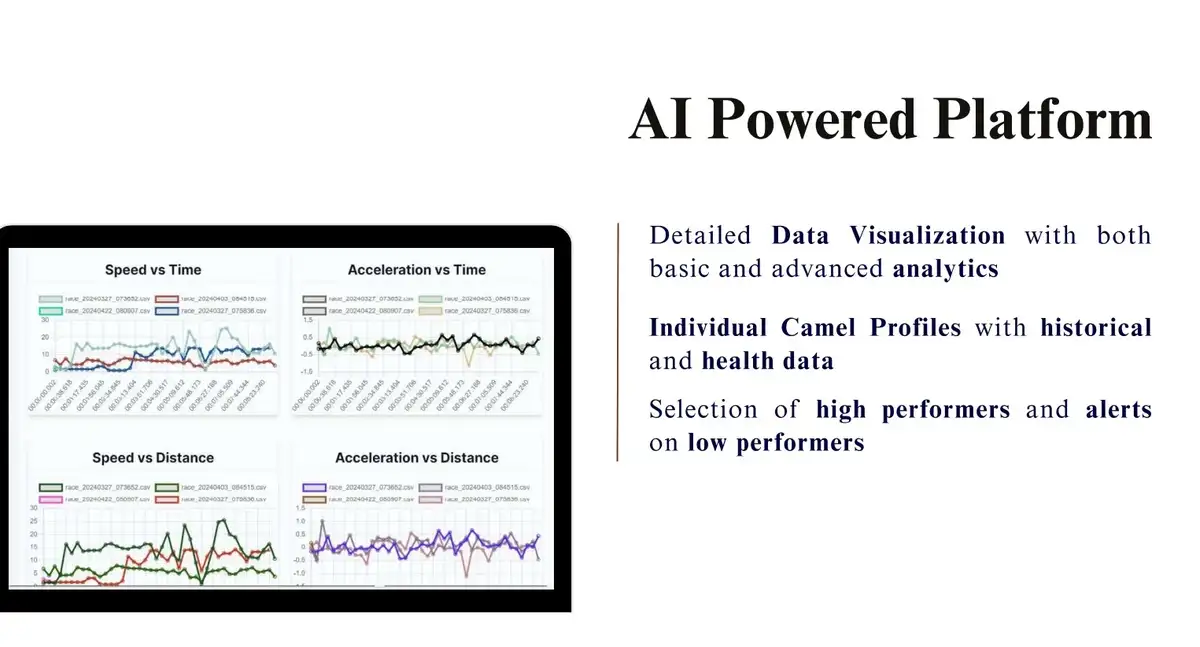
IoT sensors convert every training session into a scientific dataset.
Now, trainers can see:
Exact speed at every moment
Acceleration curves
Distance covered
Optimal and weak training zones
Performance drop during fatigue
Peak effort moments
Running pattern consistency
AI then analyzes this data to show trends:
Is the camel improving?
Is it slowing down at the same point every day?
Is its stride pattern becoming unstable?
Is it reaching peak performance too early or too late in the run?
This transforms training from:❌ Guessingto✅ Knowing
🌟 Real Impact for Trainers
With data, trainers can:
Design training sessions based on each camel’s unique profile
Identify the camels with the highest racing potential early
Prevent undertraining and overtraining
Adjust workloads with confidence
Build a complete history of each camel’s performance
When performance becomes measurable, improvement becomes predictable.