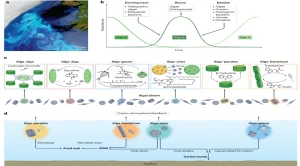
Harmful algal blooms (HABs) are a growing concern in UAE waters, affecting marine life, human health, and local industries. These blooms occur when certain algae grow rapidly, producing toxins that can harm fish, contaminate seafood, and degrade water quality. Common species in the UAE include dinoflagellates like Marglefidinium polykrikoides and Prorocentrum minimum, as well as diatoms such as Chaetoceros tenuissimus, Fragilaria radians, Phaeodactylum tricornutum, and Skeletonema marinoi.
Recent research has focused on proteins called metacaspases, which are involved in cell death and other critical cellular processes in these algae. Studying metacaspase proteins helps scientists understand the evolutionary relationships between different algae species and how these proteins may contribute to the occurrence and severity of HABs.
By comparing metacaspase proteins from various algae species, researchers can identify similarities and differences that reveal evolutionary patterns. Techniques such as sequence alignment and phylogenetic analysis allow scientists to map these relationships, showing which species are closely related and how their proteins may function in harmful blooms.
For example, studies have shown that the metacaspase proteins of Chaetoceros tenuissimus are closely related to those of Phaeodactylum tricornutum, Fragilaria radians, and Skeletonema marinoi. Similarly, Prorocentrum minimum and Marglefidinium polykrikoides share significant protein similarities. Understanding these connections helps researchers predict which algae may cause blooms and informs strategies to monitor and mitigate their impact. Reference
Fujairah Research Centre