Sustainable food security in arid climates requires decoupling food production from high water consumption. The Fujairah Research Centre (FRC) utilizes Recirculating Aquaculture Systems (RAS) to achieve this, employing a closed-loop technology that filters and reuses up to 99% of its water. This article examines the biological and mechanical engineering that allows RAS to maintain high-density aquatic life with minimal environmental impact.
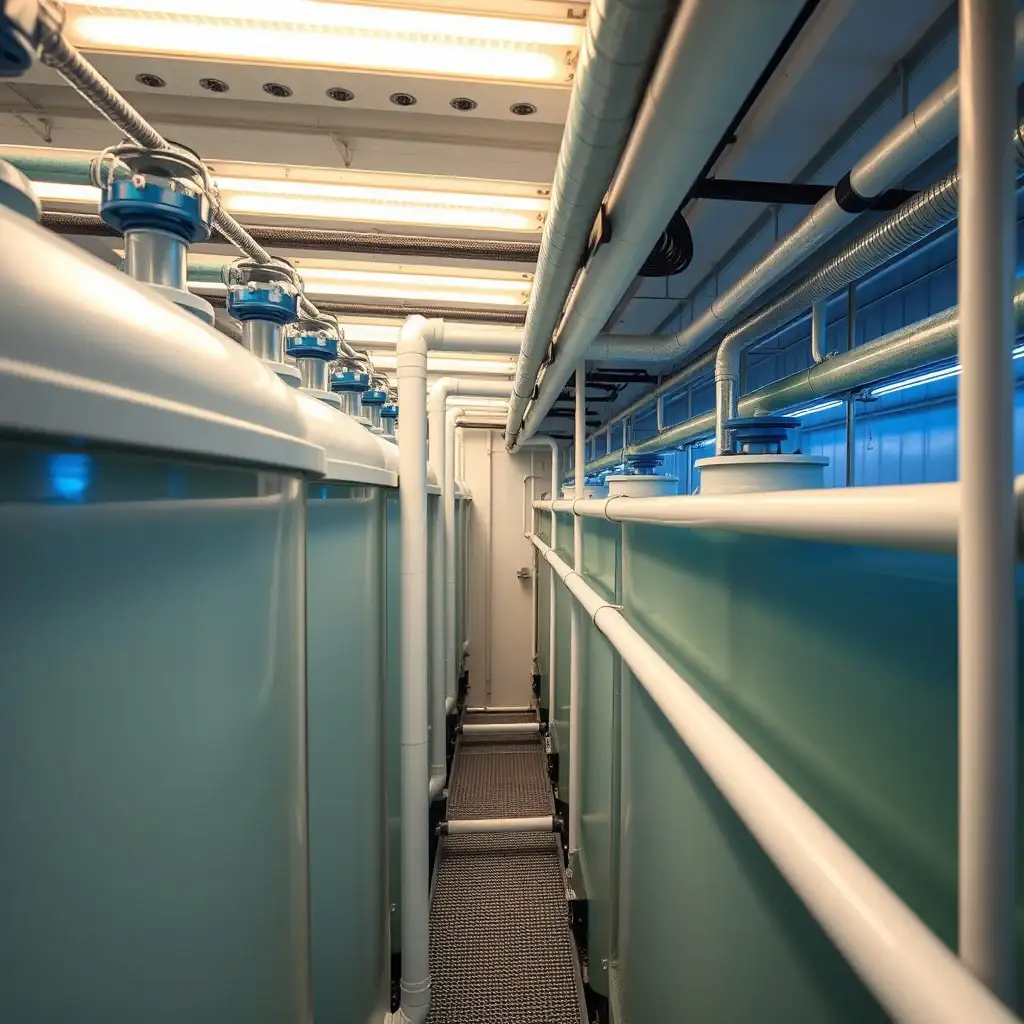
The Mechanism of Water Recovery
Unlike traditional flow-through systems that constantly draw and discharge water, RAS operates as a self-contained ecosystem. The technical challenge is to continuously remove metabolic waste products—primarily ammonia and carbon dioxide—before they reach toxic levels. This is achieved through a multi-stage filtration process:
Mechanical Filtration: The first stage removes solid waste (uneaten feed and feces) using drum filters or swirl separators. Rapid removal of solids is vital to prevent the organic load from breaking down and consuming oxygen.
Biological Filtration (Biofiltration): This is the heart of the RAS. It utilizes beneficial nitrifying bacteria (Nitrosomonas and Nitrobacter) housed on specialized media. These bacteria perform a two-step biological process: converting toxic ammonia into nitrite, and then into relatively harmless nitrate.
Degassing and Oxygenation: Water is stripped of dissolved carbon dioxide and re-saturated with pure oxygen to maintain optimal levels for fish respiration at high stocking densities.
Pathogen Control and Biosecurity
Because RAS is a closed environment, preventing the introduction of pathogens is critical. FRC employs UV Sterilization and Ozone Treatment to disinfect the circulating water. These technologies disrupt the DNA of harmful bacteria and viruses without the need for chemical antibiotics, ensuring that the fish are raised in a sterile, controlled environment.
Precision Monitoring through Real-time Sensing
To maintain the delicate balance of the closed-loop system, FRC integrates automated water quality sensors. These sensors provide a constant stream of data on dissolved oxygen, pH, temperature, and salinity levels. By monitoring these parameters in real-time, the system can automatically adjust oxygen flow or filtration speeds to compensate for changes in fish behavior or environmental conditions. This level of precision minimizes stress on the aquatic life and prevents system failures before they occur.
Enhancing Resource Efficiency
By precisely controlling water chemistry, temperature, and light cycles, RAS allows for year-round production regardless of outdoor weather conditions. This "indoor" approach to aquaculture significantly reduces the footprint of fish farming and eliminates the risk of nutrient discharge into local marine ecosystems. Through the refinement of these systems, FRC provides a scalable model for high-efficiency protein production that aligns with the UAE's circular economy goals.
Frequently Asked Questions
How does RAS save water compared to traditional fish farming?
Traditional farms require a constant flow of fresh water to flush out waste. Recirculating Aquaculture Systems (RAS) use advanced mechanical and biological filters to clean the water so it can be reused, reducing total water usage by over 95%.
What is a "Biofilter" and why is it necessary?
A biofilter is a tank filled with media that grows "good" bacteria. These bacteria act as a natural cleaning system, converting the toxic ammonia produced by fish waste into harmless nitrate, keeping the water safe for the fish.
Does RAS require the use of chemicals or antibiotics?
No. Because the environment is strictly controlled and water is sterilized using UV light and Ozone, the risk of disease is very low. This allows for the production of healthy fish without the need for chemical additives.