Cetaceans are highly mobile marine species that pose substantial research challenges due to their wide home ranges, migratory behavior, and low detectability across vast and remote oceanic regions. These realities, combined with the high costs of systematic surveys, have created significant gaps in understanding their spatial distribution, habitat use, and vulnerability to human-induced threats, which are critical for effective conservation management. This study presents the first dedicated aerial transect survey of cetacean assemblages off the western coast of Sumatra in the southeastern tropical Indian Ocean, a region previously understudied despite its recognized importance for marine biodiversity. Conducted between May and July 2024, the survey covered 15,043 km of aerial transects and recorded 77 sightings of 10 species, including the first aerial confirmations of killer whales and pygmy killer whales. With these additions, a total of 23 species has now been documented in the region, representing 68% of Indonesia’s known cetaceans. Our non-metric multidimensional scaling revealed seven distinct cetacean assemblage clusters strongly influenced by seafloor geomorphology and productivity gradients. High-density hotspots, dominated by spinner and striped dolphins, were found predominantly in non-protected areas, with 93% located outside existing or proposed MPAs. The overlap of cetacean habitats with intensive fishing activities and maritime traffic highlights potential risks for species such as killer whales, Omura’s whales, and sperm whales. These findings emphasize the need for targeted spatial protection, adaptive marine spatial planning, and species-specific mitigation measures to complement Indonesia’s 30×45 MPA expansion efforts. Given its exceptional biodiversity and the presence of threatened species such as sperm whales, western Sumatra is a strong candidate for designation as an important marine mammal area, consistent with its status as an ecologically or biologically significant marine area. This study establishes a critical ecological baseline, demonstrating the value of large-scale aerial surveys for informing evidence-based cetacean conservation in Indonesia’s offshore habitats.
1 Introduction
Highly mobile species such as cetaceans are inherently difficult to study due to their extensive home ranges, migratory behavior, and low detectability across vast and often remote oceanic regions (Read, 2018; Hupman et al., 2018). These challenges, combined with the high costs of field surveys, often lead to significant data gaps, particularly in understanding their spatial distribution, habitat use, and the threats they face (Kaschner et al., 2012). Yet, such knowledge is fundamental for developing effective conservation strategies (Pace et al., 2019). A clear understanding of where cetaceans feed, reproduce, and their migration routes is essential for ensuring that management measures can support population recovery and long-term resilience (IJsseldijk et al., 2021; Wild et al., 2023). Without these insights, conservation planning risks overlooking critical habitats and high-use areas that are vital for sustaining healthy cetacean populations (Hoyt, 2012).
Cetaceans provide crucial ecosystem functions and services, acting as ecosystem engineers that regulate food webs, recycle nutrients, and contribute to carbon sequestration through mechanisms such as the whale pump and whale conveyor (Sheehy et al., 2022; Kiszka et al., 2022). Their role as apex predators maintains ecological balance (Katona and Whitehead, 1988), and their sensitivity to environmental change makes them valuable bioindicators of ocean health (Zantis et al., 2021; Garcia-Bustos et al., 2024). However, poorly informed management, combined with persistent threats including bycatch (Read, 2008; Reeves et al., 2013), vessel traffic (Pennino et al., 2017), noise pollution (Barlow and Gisiner, 2005; Henderson et al., 2014), habitat degradation (Weir and Pierce, 2013), and marine debris (Williams et al., 2011), continues to endanger cetacean populations, puts these invaluable ecosystem services at risk, many of which are irreplaceable.
Marine Protected Areas (MPAs) play a central role in mitigating these pressures, especially where human activity overlaps with critical habitats (Avila et al., 2018). Their effectiveness depends on integrating fisheries management measures such as gear restrictions and seasonal closures with spatial planning based on empirical data (Grau Tomás and García Sanabria, 2022). Yet, many MPAs have been established with limited ecological information, often excluding key cetacean habitats (Mouton et al., 2022; Filatova et al., 2022). In Indonesia, for example, only two of more than 170 MPAs were specifically designed for cetaceans (Sahri et al., 2020a). Static MPA boundaries typically protect coral reefs or coastal ecosystems, but frequently overlook pelagic and deep-sea habitats including canyons, seamounts, and upwelling zones used by cetaceans for foraging and migration (Grantham et al., 2011; Bearzi, 2012; Giménez et al., 2023; Lezama-Ochoa et al., 2025). Consequently, a significant mismatch persists between protected areas and the spatial needs of cetaceans (Sequeira et al., 2025).
To close this gap, large-scale observation methods such as aerial surveys are critical for mapping cetacean distribution and abundance across wide, data-poor regions (Panigada et al., 2024; Paiu et al., 2024). Aerial transect surveys offer broad coverage but remain challenging in Indonesia’s vast archipelagic setting due to high operational costs, limited infrastructure, and dependence on favorable weather and sea-state conditions (Ender et al., 2014; Sahri et al., 2020b). These challenges have restricted previous research mostly to coastal waters, leaving offshore habitats largely unexplored.
In line with the global 30×30 conservation target (Sequeira et al., 2025), Indonesia has adopted the 30×45 vision, aiming to protect 30% of its marine territory by 2045 (Direktorat Konservasi Ekosistem dan Biota Perairan, 2024). To support this vision, we conducted a dedicated aerial transect survey along western Sumatra, one of Indonesia’s least studied yet ecologically significant regions. Previous reports documented approximately 21 cetacean species in the area (Mustika et al., 2015), highlighting its potential as a biodiversity hotspot within Indonesia’s total of 34 known species. However, most of these records come from coastal surveys or opportunistic strandings, with minimal information on offshore distribution.
This study provides the first large-scale aerial assessment of cetaceans in western Sumatra, aiming to (1) estimate relative abundance and diversity, (2) identify spatial distribution patterns, and (3) evaluate overlap with existing and proposed MPAs, as well as potential anthropogenic threats. The findings offer crucial insights to guide Indonesia’s forthcoming MPA expansion and ensure that high-density cetacean habitats are effectively integrated into evidence-based conservation planning.
2 Materials and methods
2.1 Site description
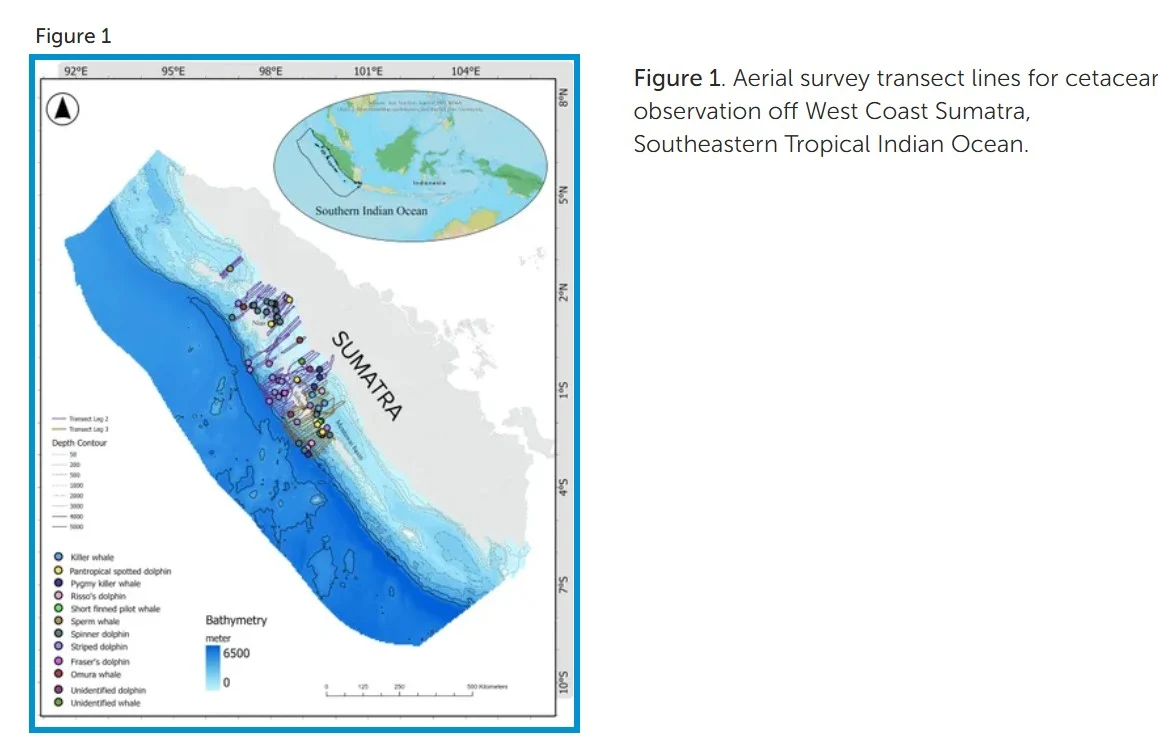
The western coast of Sumatra (8°N–10°S, 92°E–105°E) lies along the Southeastern Indian Ocean, where shallow coastal shelves drop steeply to over 6,500 m (Figure 1). Its oceanography is dominated by tropical monsoons and equatorial currents, with the southeast monsoon (June–October) driving strong upwelling that brings nutrient-rich, cooler waters to the surface, enhancing productivity (Susanto et al., 2001; Du et al., 2005; Halkides and Lee, 2009). Upwelling intensity is strongest off southern Sumatra due to wind forcing and bathymetric influence and weakens during the northwest monsoon when downwelling Kelvin waves deepen the thermocline (Susanto et al., 2001). Interannual variability is closely tied to ENSO events, where El Niño strengthens upwelling and cools SSTs by up to 4°C, while La Niña deepens the thermocline through the Indonesian Throughflow, reducing productivity (Horii et al., 2020).