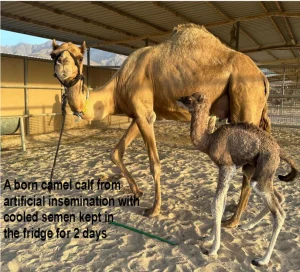
Camels play an important role in many regions of the world, supporting transportation, food production, and cultural traditions. Improving breeding practices is essential to maintain healthy populations and protect valuable genetic traits. One major challenge in camel breeding has been the short-term preservation of camel semen, especially when stored at low temperatures.
Unlike other livestock, camel semen is difficult to preserve. Its thick consistency makes handling and processing more complex. In addition, camel sperm cells are sensitive to cooling. When semen is stored at around 5°C, sperm membranes can be damaged, reducing movement and fertility. There is also a higher risk of bacterial contamination during semen collection, which can further affect quality. Another limitation has been the lack of preservation solutions specifically designed for camel semen.
A recent breakthrough has shown that camel semen can remain fertile for up to three days when stored at 5°C. This was made possible by developing a specialized semen extender designed to meet the unique needs of camel sperm. The extender helps protect sperm cells, maintain proper balance, and reduce damage caused by cooling. Careful collection methods, slow cooling, and regular quality checks also played a key role in achieving this success.
This advancement offers several important benefits for camel breeding. It reduces the need to transport animals over long distances, lowering costs and minimizing stress on the animals. Semen can be safely transported instead, making breeding programs more efficient. It also allows breeders to share valuable genetic material across regions, helping preserve genetic diversity. Controlled breeding methods can improve offspring quality and support sustainable breeding practices.
While this achievement marks significant progress, further research is still needed. Improving preservation methods and extending storage time will open new possibilities, including long-term storage solutions.
In summary, the successful short-term preservation of camel semen at low temperatures represents a major step forward for camel breeding. It simplifies breeding logistics, reduces costs, improves animal welfare, and supports the long-term sustainability of camel populations.
Reference:
Fujairah Research Centre