Authors: Hanan Rashed Alsharari Aldhanhani, Shaher Bano Mirza*, Fouad Lamghari Ridouane.
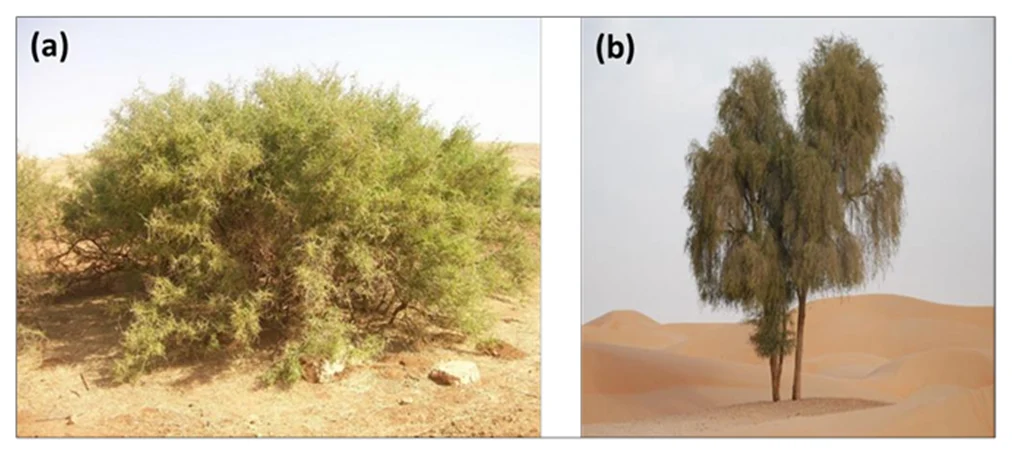
Native UAE fodder plants from Fujairah: (a) Ziziphus spina-christi (Sidr) and (b) Prosopis cineraria (Ghaf), prioritized for Arabian tahr through macro-mineral comparison analysis.
Abstract: Ziziphus Spina Christi and Prosopis Cineraria are important native plants of the United Arab Emirates flora that can cope up with harsh environmental conditions. These plants have the ability to tolerate salty soils, high temperatures, and drought environment which made it important to discover the why’s behind that. The study focused on the better nutritional plamt for Arabian Tahr, which is endangered goat and native to UAE. The nutritional values of Ziziphus Spina Christi and Prosopis Cineraria were studied using proximate analyses set by international standard procedures (Association of Official Analytical Chemists, AOAC 2001.11, AOAC 920.39, AOAC 962.29, AOAC 942.05), state of the art techniques with instruments ie, ICPOES, HPLC Gravimetry and Kjaldhal apparatus. The study scope is to determine the ability of the Ziziphus Spina Christi in comparison with Prosopis Cineraria to provide good energy sources of minerals such as potassium, calcium, and magnesium. Later, to identify which one is more beneficial to be included in Arabian Tahr’s diet. The study concluded that the Prosopis Cineraria bears more neutritional values for Arabian Tahr as compared to Ziziphus Spina Christi. The Prosopis Cineraria comprise of higher values of magnesium, potassium, and calcium which is an important part of Arabian Tahr’s diet.