Air quality in cities is a growing concern, as pollutants like non-methane hydrocarbons (NMHCs) can harm both the environment and human health. NMHCs are a group of volatile organic compounds that contribute to ground-level ozone and other pollutants, worsening respiratory issues and environmental degradation.
Traditional air monitoring methods often struggle to pinpoint the sources of these pollutants due to limited spatial and time-based data. However, modern electronic nose (eNose) sensors offer a new approach. These sensors work like a human nose, detecting and measuring NMHCs in real-time, providing detailed minute-by-minute data.
By strategically placing these sensors in high-emission areas such as industrial zones, busy roads, and densely populated districts, researchers can track pollutant patterns with greater accuracy. When combined with meteorological information like wind speed and direction, eNose sensors help create models showing how pollutants move through urban environments.
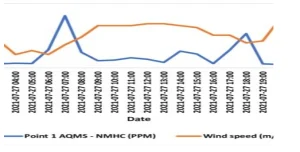
Studies show that wind speed has a clear impact on NMHC levels. Low wind speeds can lead to higher pollutant concentrations in traffic-heavy areas because dispersion is limited. Conversely, stronger winds can reduce local concentrations by dispersing pollutants, though they may carry them to other locations. For example, in one urban study, higher NMHC levels were observed when winds blew from the southeast, indicating likely emission sources.
Understanding these patterns allows cities to develop more targeted air quality management strategies. Continuous monitoring with sensors like eNoses provides valuable real-time insights, helping authorities respond quickly to pollution spikes and plan for cleaner, healthier urban environments.
As urban areas continue to grow and industrial activity expands, integrating advanced technologies such as eNose sensors and IoT solutions will be crucial to maintaining sustainable air quality and public health. Reference
Fujairah Research Centre