Building the UAE’s New Era of Climate Preparedness
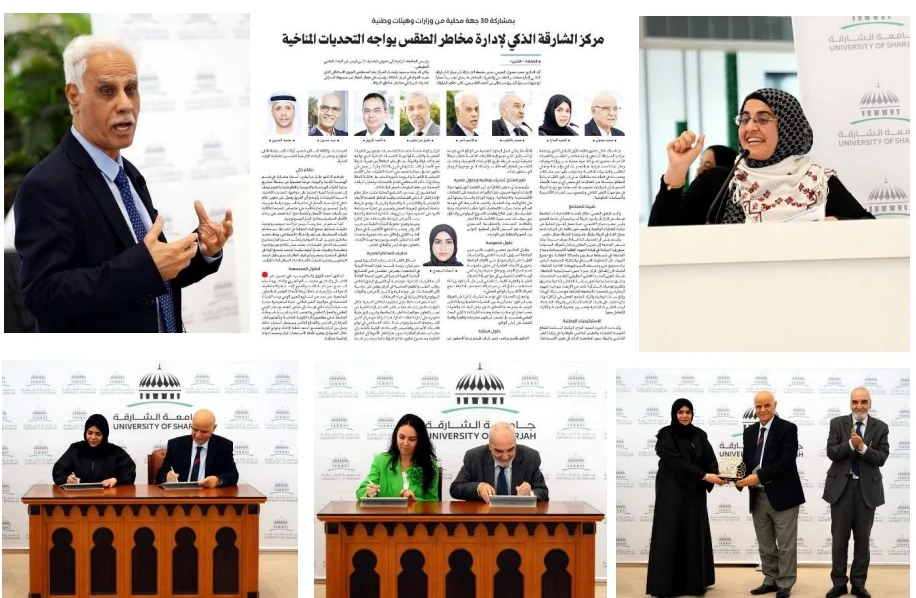
After witnessing the heaviest rainfall ever recorded in the UAE since 1949, Sharjah has taken a decisive step: the creation of the Sharjah Smart Center for Climate Resilience (SSCCR). Backed by the vision of His Highness Sheikh Sultan bin Ahmed Al Qasimi and powered by the multidisciplinary strength of the University of Sharjah, this center is emerging as a flagship institution for climate science, policy innovation, and community resilience.
A Center Built for a New Climate Reality
Recent extreme weather events have exposed how much is at stake—homes, infrastructure, water systems, public health, and economic stability. SSCCR responds to this national urgency with a clear mandate:advance climate resilience by blending cutting-edge research, artificial intelligence, remote sensing, community engagement, and strong policy frameworks.
The center combines experts in engineering, public health, social sciences, disaster management, GIS, AI, and environmental sciences to create solutions that work in real-world conditions.
What the Center Stands For
A Bold Vision
To lead the region in climate resilience by empowering the UAE with advanced science, innovative technologies, and policies that protect communities and ecosystems.
A Strong Mission
To advance the UAE’s climate agenda through research, data-driven risk management, early warning systems, and partnerships with national and international institutions.
Core Objectives Driving Impact
1. Research & Innovation
Develop AI-based climate models, prediction systems, flood simulations, and resilience frameworks for infrastructure, health, and communities.
2. National Climate Data Platform
Build and maintain a comprehensive database for early warnings, vulnerability maps, and cross-sector data sharing.
3. Capacity Building & Community Awareness
Train professionals, students, volunteers, and journalists. Run public campaigns to reduce misinformation and improve disaster readiness.
4. Policy Development
Work with policymakers to embed climate risk management into UAE legislation and national strategies.
5. Strategic Partnerships
Collaborate with ministries, agencies, universities, emergency authorities, and international institutions to strengthen national preparedness.
A Structured and Effective Organization
The SSCCR operates under:
Governing Advisory Board
Center Director & Deputy Director
Core Workgroups
Flood Research & Predictive Analytics
Disaster Risk Assessment
Community Engagement & Crisis Communication
Public Health & Climate Impact
Technology & Data Science (AI, GIS, Sensors, Remote Sensing)
Volunteer & Outreach Programs
Administration Support (HR, Finance, Logistics)
This structure ensures the center delivers both scientific excellence and operational efficiency.
Major Achievements
1. Policies & Procedures Completed
A full operational and governance framework was approved, setting strict standards for ethics, data management, KPIs, and research excellence.
2. Active Research Clusters Launched
Including:
Flood risk management & smart cities
Water security & green economy
Public health impacts of floods
Psychosocial impacts on emergency responders
Disaster awareness & volunteer training
3. Strategic Projects in Progress
With Sharjah National Oil Corporation (SNOC):
GIS-based flood mitigation & automated pumping
AI-enhanced oil–water separation
With the Ministry of Climate Change & Environment (MoCCE):
Soil stabilization with native plants
Desertification reversal
Endangered mountain plant conservation
Digital dust belt monitoring
Decarbonization & CO₂ reduction roadmap
Transportation air quality impact study
Flood prediction models
Atmospheric water extraction technologies
High-Level Engagement & National Collaboration
Between January and May 2025, SSCCR engaged with over 27 national and international organizations, including:
National Meteorology Center
Ministry of Climate Change & Environment
UAE Space Agency
Mohammed bin Rashid Space Centre
Sharjah Municipality
Dubai Police
Abu Dhabi Police
DEWA & DEWA R&D
Fujairah Environment Authority
Roads & Transport Authorities
Sharjah Civil Defense
Meetings, workshops, and MoUs are accelerating cooperation across government and academia—showing how climate resilience requires shared responsibility and shared data.
Technical Exchange Meeting: A Major Milestone
Held on February 26, 2025, this event brought together climate scientists, policymakers, GIS experts, emergency authorities, and sustainability leaders.Key themes included:
Integrating AI, GIS, and remote sensing for better forecasting
Developing unified national disaster policies
Improving water security & air quality monitoring
Strengthening coordination for emergency response
Images in the report show packed auditoriums, national leaders discussing flood models, and strong government representation—proof of how seriously this agenda is being taken.
Why the SSCCR Matters
The UAE is entering a climate era where adaptation is no longer optional—it’s essential.
The SSCCR is not just a research unit. It is a national resilience engine, built to protect lives, infrastructure, and natural resources through:
science
innovation
policy
community empowerment
intergovernmental cooperation
As extreme weather becomes more frequent, centers like SSCCR define the future of readiness for the UAE and the region.