Authors: Robert K. Browne, Qinghua Luo, Pei Wang, Nabil Mansour, Svetlana A. Kaurova, Edith N. Gakhova, Natalia V. Shishova, Victor K. Uteshev, Ludmila I. Kramarova, Govindappa Venu, Mikhail F. Bagaturov, Somaye Vaissi, Pouria Heshmatzad, Peter Janzen, Aleona Swegen, Julie Strand and Dale McGinnity
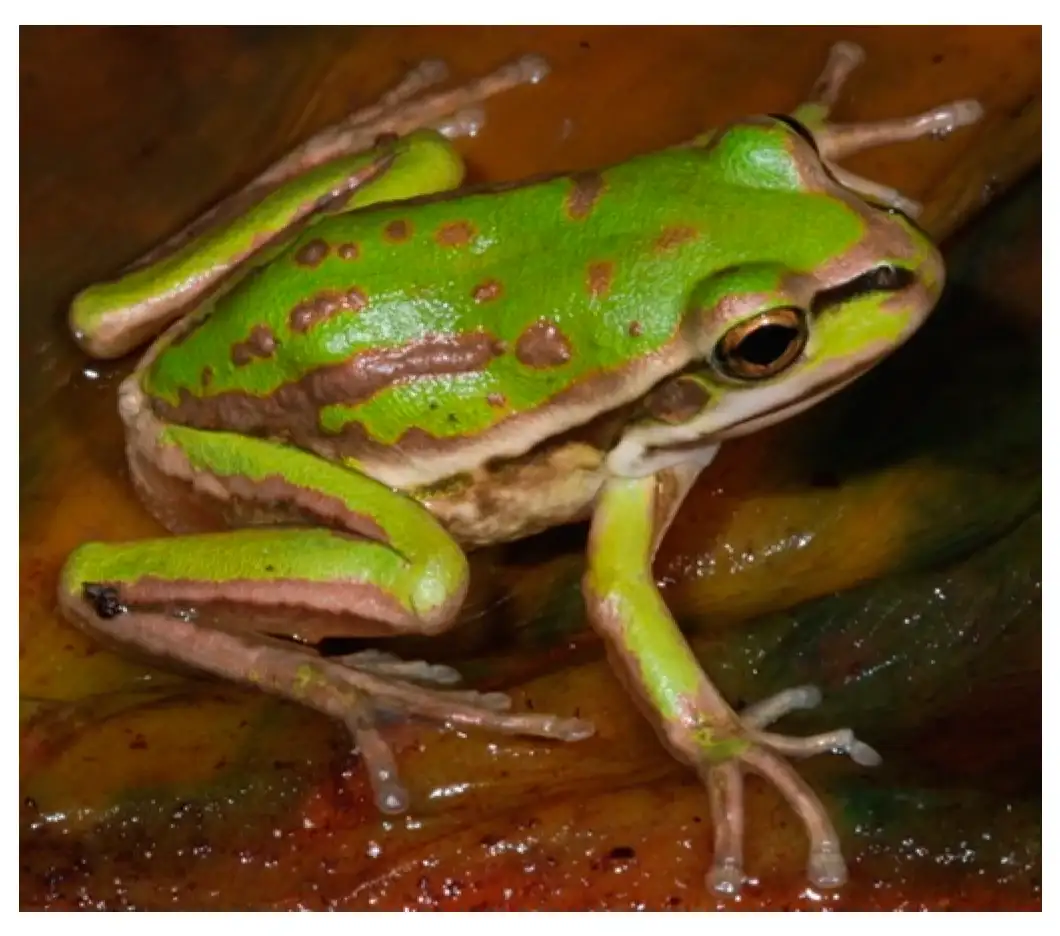
The most common color morph of the green and golden bell frog, Ranoidea (Litoria) aurea, showing characteristic green and gold patterning, a target species for conservation breeding, germplasm biobanking, and advanced reproductive biotechnologies addressing the sixth mass extinction.
Simple Summary:
Primary themes in intergenerational justice are a healthy environment, the perpetuation of Earth’s biodiversity, and the sustainable management of the biosphere. These goals demand transformative changes to biodiversity management, especially when considering the predicted sixth mass extinction. Reproduction and advanced biotechnologies, biobanks of germplasm and somatic cells, and conservation breeding programs (RBCs) provide a transformative change to perpetuate biodiversity irrespective of environmental targets, ecosystem collapses, and other sixth mass extinction drivers. Future potentials for RBCs include assisted evolution, species restoration, and the extension of the biosphere through interplanetary and interstellar colonization. We address these themes with amphibian models to introduce the MDPI Special Issue, The Sixth Mass Extinction and Species Sustainability through Reproduction and Advanced Biotechnologies, Biobanking, and Conservation Breeding Programs.
Abstract:
Primary themes in intergenerational justice are a healthy environment, the perpetuation of Earth’s biodiversity, and the sustainable management of the biosphere. However, the current rate of species declines globally, ecosystem collapses driven by accelerating and catastrophic global heating, and a plethora of other threats preclude the ability of habitat protection alone to prevent a cascade of amphibian and other species mass extinctions. Reproduction and advanced biotechnologies, biobanking of germplasm and somatic cells, and conservation breeding programs (RBCs) offer a transformative change in biodiversity management. This change can economically and reliably perpetuate species irrespective of environmental targets and extend to satisfy humanity’s future needs as the biosphere expands into space. Currently applied RBCs include the hormonal stimulation of reproduction, the collection and refrigerated storage of sperm and oocytes, sperm cryopreservation, in vitro fertilization, and biobanking of germplasm and somatic cells. The benefits of advanced biotechnologies in development, such as assisted evolution and cloning for species adaptation or restoration, have yet to be fully realized. We broaden our discussion to include genetic management, political and cultural engagement, and future applications, including the extension of the biosphere through humanity’s interplanetary and interstellar colonization. The development and application of RBCs raise intriguing ethical, theological, and philosophical issues. We address these themes with amphibian models to introduce the Multidisciplinary Digital Publishing Institute Special Issue, The Sixth Mass Extinction and Species Sustainability through Reproduction Biotechnologies, Biobanking, and Conservation Breeding Programs.
Reference: