Camel racing has always relied on deep experience, intuition, and close observation. Trainers spend hours watching their camels, trying to understand subtle differences in gait, stamina, and behaviour. But as herds grow and competition intensifies, one challenge stands out above all:
1. The Difficulty of Monitoring Every Camel During Training
Let’s be honest—No trainer, no matter how skilled, can fully monitor every camel with the same precision at the same time.
Traditional training depends on:
Visual observation during runs
General comparison between camels
Human estimates of speed, stress, or fatigue
Notes that change from day to day
No objective data to measure progress or detect early problems
And the result?Some camels get overworked. Others underperform without clear reasons. Small gait deviations go unnoticed until they become real injuries. A trainer’s intuition is valuable—but intuition alone is no longer enough.
🚀 The New Methodology: IoT + AI Transforming Camel Training
Our new approach changes the entire equation.
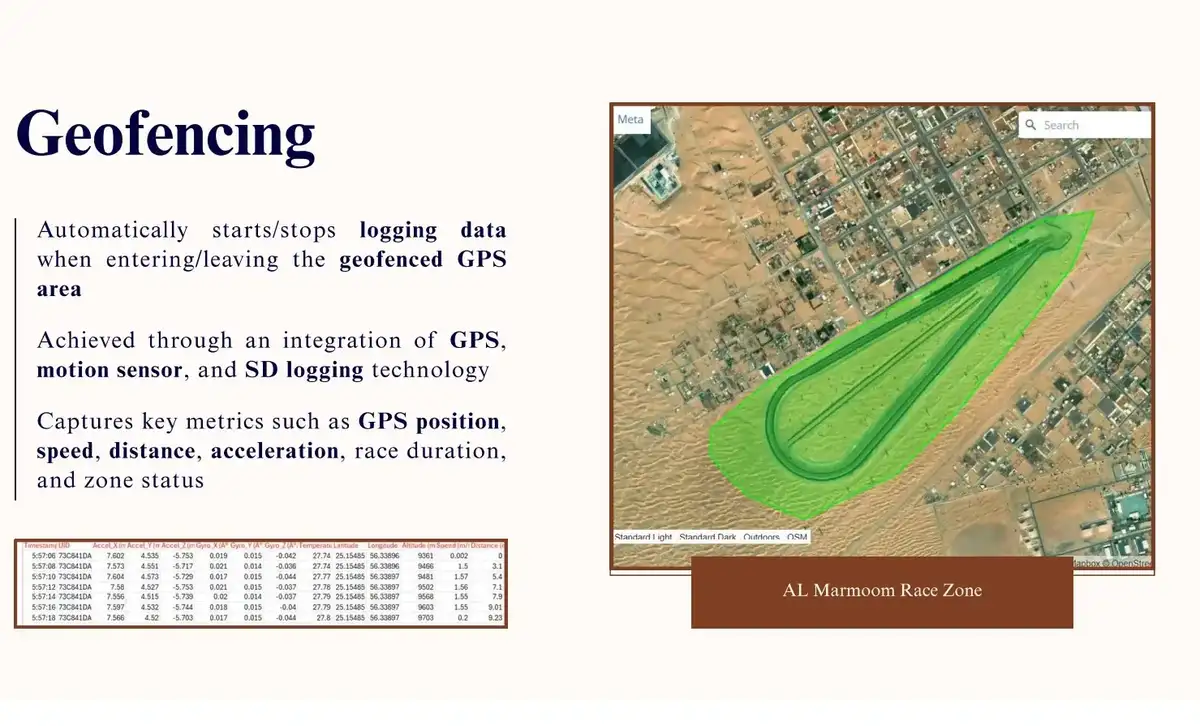
By combining IoT sensors with AI analytics, every camel becomes fully visible—every second, every step, every change in performance.
With this system, trainers can:
Track each camel individually during every run
Measure speed, acceleration, distance, heart-related effort (when available), and biomechanical patterns
Detect early signs of fatigue or imbalance
Compare today’s performance with historical trends
Make data-driven decisions about workload and readiness
Instead of guessing, trainers now know.
Instead of “I think this camel is tired,”we say:“Acceleration dropped 12% in the last 200 meters—reduce workload today.”
Instead of “This camel looks fine,”we say:“Left-side stride symmetry decreased—check for discomfort.”
🌟 Why This Matters
Camel racing is becoming more competitive, more scientific, and more demanding. Data doesn’t replace the trainer—it empowers the trainer.
This transition is not about technology for the sake of technology.It’s about giving every camel the care, precision, and optimized training it truly deserves.